html Verdun travel guide | The citadel, the quays and the battlefield | Frankrike.no Skip to content
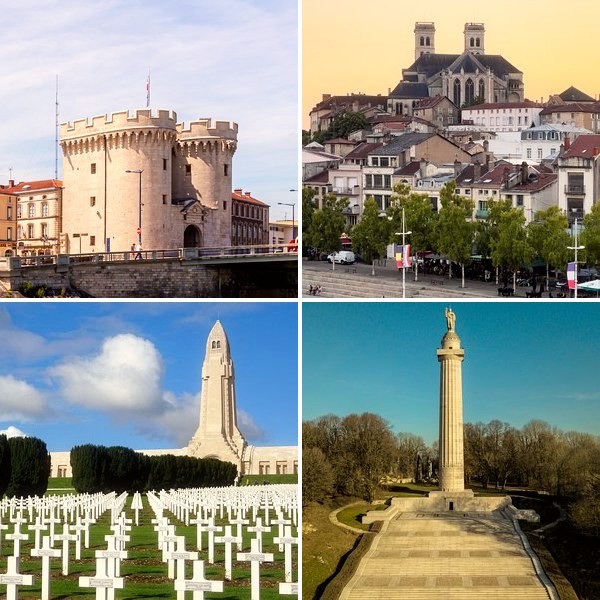
Montage of the Tour Chaussée in Verdun, the cathedral above the town in evening light, the Douaumont Ossuary with white crosses and the American monument in MontfauconMeuse · River town, citadel and memorial sites
France travel guide

Verdun

Verdun lies on the river Meuse in Lorraine, with quays, canals and a cathedral begun in 990. The town is best known for the battle in the First World War, which lasted from 21 February to 18 December 1916.

Around 300,000 soldiers on both sides were killed or went missing in 1916, according to the Mémorial de Verdun, but the figures vary between sources. In the Citadelle souterraine the Unknown Soldier was chosen on 10 November 1920. He lies under the Arc de Triomphe in Paris.

The TGV from Paris Est to Meuse TGV takes one hour, and from there a bus runs to Verdun. From here you can reach the ossuary and Fort de Douaumont, Fort de Vaux, the Argonne, Saint-Mihiel and the Lac de Madine.

The citadel and the Meuse quaysDouaumont and Fort de VauxThe Argonne and the Lac de Madine
Best forFirst World War memorial sites, citadel, river quays, cathedral, cycling along the Meuse and day trips to the Argonne and the Lac de Madine
Ideal forHistory enthusiasts, adults, couples, families with older children, cyclists and anyone on a tour of Lorraine
Easy to exploreThe quays, the cathedral and the Monument à la Victoire on foot; the battlefield by car, taxi, bike or guided tour; La Meuse à vélo through the town
Excellent base forDouaumont Ossuary and Fort de Douaumont, Fort de Vaux and the Mémorial de Verdun, Montfaucon and Vauquois, Saint-Mihiel and the Lac de Madine
Highlights

Discover Verdun

Ride through the galleries of the Citadelle souterraine, walk the quays to the Tour Chaussée, and see the cathedral and the Monument à la Victoire. The memorial sites at Douaumont, Vaux and Fleury are five to eight kilometres away.

Suggested itineraries

Verdun in 1, 3 or 5 days

Choose how long you are staying, and combine the town and the citadel with the battlefield, the Argonne and the Meuse valley.

A classic day in Verdun

With a car, one day is enough for the citadel, the quays and the cathedral, and the ossuary and Fort de Douaumont in the afternoon. If you want to see all the major memorial sites, you need at least one more day.

MorningStart at the Citadelle souterraine when it opens, at 9am in April–October 2026. The visit takes 1 hr 30 min, it is 8°C in the galleries, and in high season you should book.
Late morningWalk to the cathedral and the Monument à la Victoire, and on along the Quai de Londres to the Tour Chaussée. They are all less than one kilometre apart as the crow flies.
AfternoonDrive to the Douaumont Ossuary, around six kilometres to the north-east, and on to Fort de Douaumont. Allow one hour in the ossuary and 1 hr 30 min in the fort.
EveningEat by the river. Le Bistro d'Élo on the Quai de Londres is open in the evening Thursday–Saturday, and La Brasserie d'Agnès on the Avenue de la Victoire is open every day until 31 December 2026.
Choose the right area

Where should you stay in Verdun?

The choice is between the centre, the Meuse quays, the hotels outside the town centre, the village of Vacherauville near the battlefield or a château and a lake further south. It decides how much you can do on foot, and how far you have to drive.

The centre

By the cathedral

The 3-star Hôtel de Montaulbain has ten rooms on a quiet street in the middle of the town, a short distance from the cathedral and the Quai de Londres.

On foot to the quays, the cathedral and the Monument à la Victoire.
Four stars and a hotel boat

The Meuse quays

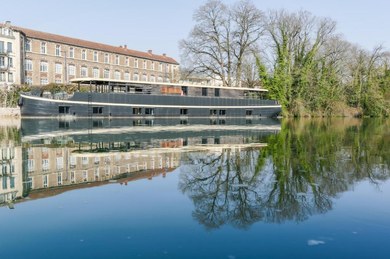
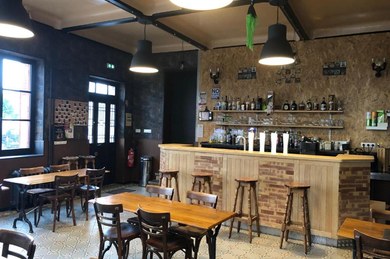
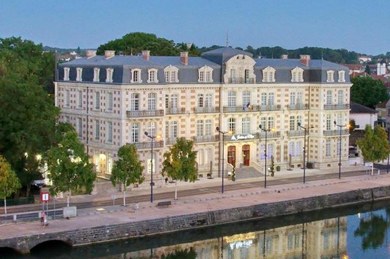
The 4-star Les Jardins du Mess with a spa is in the former officers’ mess on the Quai de la République, and the 3-star SAVY is a floating hotel with eight rooms by the Tour Chaussée.

Closest to the river, the boats and the restaurants on the Quai de Londres.
Pool and park

Outside the town centre

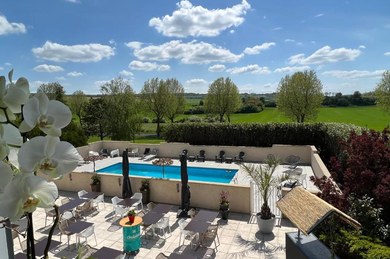
The 3-star Les Orchidées has two hectares of grounds, a pool and a restaurant, around 2.6 kilometres east of the centre as the crow flies, and the 2-star Hôtel du Tigre is on the Avenue de Paris.

Suits anyone arriving by car. Les Orchidées is around four kilometres from the battlefield.
Near the battlefield

Vacherauville

Le Relais du Mess has 13 rooms in Vacherauville, around seven kilometres north of Verdun as the crow flies. In 2026 the hotel was open from 10 July to 31 December.

You need a car, but Douaumont is around ten minutes away, according to Meuse Attractivité.
Château and lake

Les Monthairons and the Lac de Madine

The 4-star Château des Monthairons with a spa is on the Meuse, around 11 kilometres south of Verdun, and the 3-star Hôtel du Lac de Madine with a spa is in Heudicourt, around 34 kilometres to the south-east.

You need a car, but it is a short trip to Saint-Mihiel, Montsec and the lake.
Selected places to stay

Places to stay in and around Verdun

Here are some of our selected places to stay in Verdun, near the battlefield, on the Meuse, by the Lac de Madine and in the Argonne. Verdun has one hotel with 4 stars. Compare the location, the distance to Douaumont and the distance to the quays.
Château des Monthairons in Les Monthairons★★★★
Les Monthairons

Château des Monthairons

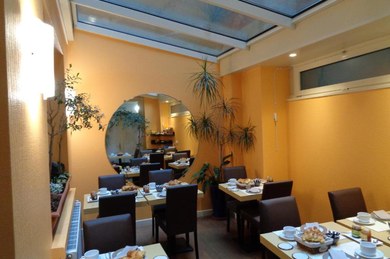
A four-star château by the Meuse with a spa and a restaurant, south of Verdun.
Les Orchidées in Verdun★★★
East of the centre

Les Orchidées

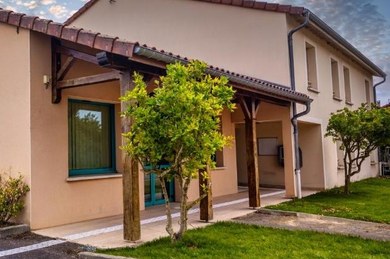
A three-star hotel with a pool, a restaurant and grounds east of town, towards the battlefield.
Le Relais du Mess in Vacherauville★★★
Vacherauville

Le Relais du Mess

A three-star hotel with 13 rooms in Vacherauville, the closest to the battlefield at Douaumont.
Maison Drapier – Lac de Madine in Heudicourt-sous-les-Côtes★★★
Heudicourt-sous-les-Côtes

Maison Drapier – Lac de Madine

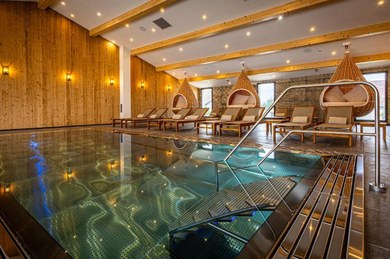
A three-star hotel with a large spa and indoor and outdoor pools near Lac de Madine.
Hôtel du Grand Monarque in Varennes-en-ArgonneHotel
Varennes-en-Argonne

Hôtel du Grand Monarque

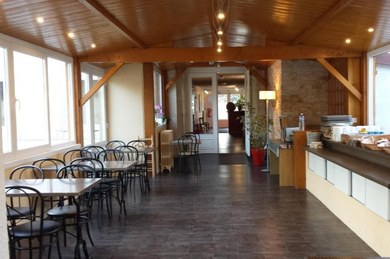
A hotel with a bar and a restaurant in Varennes, where Louis XVI was stopped in 1791.

The map shows our selected hotels in Verdun, Vacherauville, Les Monthairons, Heudicourt and Varennes. Click a marker for a photo and more information.
Camping and motorhomes

Camping near Verdun

The nearest is Les Breuils, around 1.5 kilometres from the centre, with a pool and a season from 1 April to 30 September 2027. Les Marguerites in Bonzée, around 18 kilometres away, and Kity Caravann'Inn in Dun-sur-Meuse, around 30 kilometres away, have 3 stars and the same season.

The river, the forests and the battlefield

The landscape around Verdun

Cycling along the river

La Meuse à vélo

EuroVelo 19 runs 180 kilometres through the Meuse, and from Verdun it is 45 kilometres to Dun. Find more rides in our guide to cycling in France.

Forest and river valley

The Argonne and the Meuse valley

West of Verdun lies the Argonne with Vauquois, Montfaucon and Varennes, and to the south are Saint-Mihiel and Lac de Madine. Read the article on the Argonne and the Meuse valley.

Forest over the traces of war

The Verdun battlefield

Forest now covers what was the battlefield, and some areas are closed because of ash dieback. Read the article on the Verdun battlefield, with Douaumont and Fort de Vaux.

Car hire from Paris Charles de Gaulle

A car for your day trips

Paris Charles de Gaulle (CDG) is around 206 kilometres from Verdun as the crow flies. With your own car you can also reach Douaumont, Vaux, Montfaucon, Vauquois and the Lac de Madine.

Memorial sites, forest and lake

Four good day trips from Verdun

North-east of the town lie Douaumont, Fleury and Vaux, to the north-west Montfaucon, Romagne and Vauquois in the Argonne, and to the south Saint-Mihiel and the Lac de Madine.

Continue your journey

More destinations from Verdun

Verdun fits into a tour of Lorraine and Champagne, with Metz to the east, Nancy to the south-east and Reims to the west.

The Arc Héré with a gilded group of figures on top, seen from the Place Stanislas in Nancy, with outdoor café tables in front
Place Stanislas

Nancy

Travel on to the Place Stanislas in Nancy, around 78 kilometres south-east of Verdun as the crow flies. By car it takes 1 hr 15 min.

Open the Nancy guide →
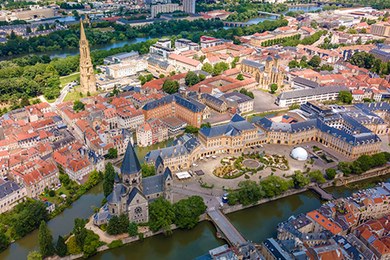
Metz from the air in summer, with the Temple Neuf church on the island in the Moselle
The city on the Moselle

Metz

Continue to the cathedral and Centre Pompidou-Metz, around 58 kilometres east of Verdun as the crow flies. The train takes 1 hr 6 min at the fastest.

Open the Metz guide →
The west front of Reims cathedral behind trees, with outdoor café tables in front
The coronation city

Reims

Combine Verdun with the coronation cathedral in Reims, around 99 kilometres west as the crow flies. The A4 runs between the two.

Open the Reims guide →
Read more

Read our inspiring articles about France

Find inspiration in travel guides, touring itineraries and personal tips from across France. Discover cities, villages, food and wine experiences, nature and new destinations.

Citadel · The Unknown Soldier

Citadelle souterraine

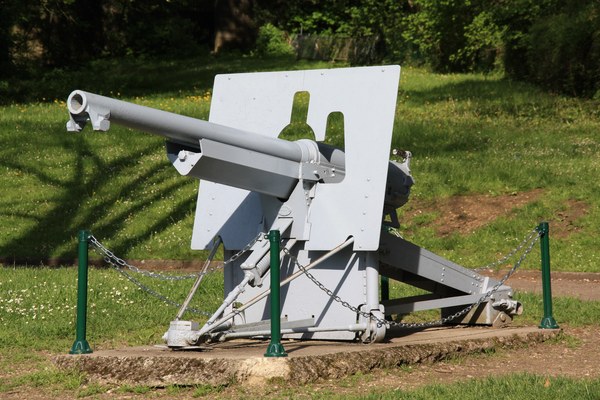
A grey cannon with a shield on a concrete base, with grass and small white flowers in front and forest behind
Image from Frankrike.no.

Henri II annexed Verdun in 1552, and the citadel was built on Mont Saint-Vanne in 1567–1634. Vauban worked here from 1687, and in 1886–1893 four kilometres of galleries were dug beneath the citadel.

In 1916 the galleries housed a headquarters, an infirmary, 1,500 soldiers and nine baking ovens that made approx. 40,000 rations a day.

On 10 November 1920 the soldier Auguste Thin chose the Unknown Soldier here by placing the bouquet on the sixth of eight coffins. The other seven lie at Faubourg Pavé in Verdun, and the Unknown Soldier was buried under the Arc de Triomphe in Paris on 28 January 1921.

The visit takes 1 hr 30 min: around 30 minutes on foot, 35 minutes in self-driving wagons with AR glasses and 30 minutes on foot. The last departure is 1 hr 30 min before closing. It is 8°C, so bring warm clothes.

The citadel does not admit children under 8 and is not advised in the case of claustrophobia, pregnancy or heart problems. Animals are not allowed, and photography is forbidden in the galleries.

Tickets cost €16, €13 reduced and €8 for children (November–December 2026). In 2026 it was open from 9am to 6pm in April–June, September and October and from 9am to 7pm in July and August. In December it is open from 9.30am to 5pm, and closed on 24, 25 and 31 December and 1 January 2027. In 2026 it was closed from 5 January to 1 February, and the times for 2027 have not been published.

€16 (2026)1 hr 30 min8°CFrom age 8
See opening times and tickets →
River · Rebuilt after 1916

The Meuse quays and the Tour Chaussée

The Meuse in Verdun in summer, with the Tour Chaussée on the right by the bridge, a row of pale houses and reflections in the green water
Image from Frankrike.no.

The Quai de Londres is a pedestrian street with around twenty bars and restaurants. The quay was completely destroyed during the battle in 1916 and rebuilt with financial support from the city of London.

The article on the Verdun battlefield explains what happened in 1916, and covers the memorial sites around the town.

The Tour Chaussée is a fourteenth-century town gate. It was part of the Grand Rempart town wall, was given by the alderman Wautrec and is linked to Verdun becoming a free imperial city in 1374.

Verdun is called ‘La Petite Venise’, as the town has five canals and 20 bridges, according to the tourist office.

Lor'n Boat on the Quai de la République is solar-powered, takes 11 people and runs every day from 1 April to 31 October 2027. A 30-minute trip costs €10, €7 for children, and a 50-minute trip with commentary €13, €9 for children. It is free for under-3s.

The Carnaval Vénitien had parades on the Meuse on 13–14 June 2026, and the dates for 2027 have not been published. We have not found any information about visiting the inside of the Tour Chaussée.

Pedestrian street by the river14th-century town gateBoat from €10On foot
See the Quai de Londres at the tourist office →
Cathedral · Begun 990

Cathédrale Notre-Dame

The cathedral of Notre-Dame in Verdun seen from the cloister garden in May, with its two square towers and the tiled roof of the cloister
Photo: MOSSOT, CC BY-SA 4.0

The cathedral was begun in 990 by Bishop Heimon on the Rhenish model, with two choirs, two transepts and four towers, and was completed in 1024. Pope Eugene III consecrated it on 11 November 1147.

It is one of the oldest cathedrals in Europe, according to Meuse Attractivité. The cloister dates from 1509–1517 and is in the Flamboyant Gothic style.

After a fire on 2 April 1755 the cathedral was rebuilt in the Baroque style, and the baldachin was completed in 1760.

In 1916 the stained glass, the vaults of the nave and the galleries of the cloister were destroyed. The new stained glass is by Jean-Jacques Gruber.

The crypt had been filled in during the eighteenth century. When the cathedral was restored, it was given capitals in 1935 with scenes from the war, including soldiers and cannons.

The cathedral is open every day all year, but no hours are given. The Musée de la Princerie close by, in a Renaissance house from 1525, is closed for the winter and opens on 1 April 2027. It is then open from 2pm to 6pm, closed on Tuesdays, until 31 October. Tickets cost €3, €1.50 reduced, and entry is free for under-18s and on the first Sunday of the month.

Begun 990Cloister 1509–1517Open every dayOn foot
See the cathedral at the Ministry of Culture →
Monument · Inaugurated 1929

Monument à la Victoire

The steep steps up to the Monument à la Victoire in Verdun in summer, with the town wall on both sides and flowers along the steps
Photo: Adam Jones from Kelowna, BC, Canada, CC BY 2.0

The Monument à la Victoire was inaugurated in 1929 by President Gaston Doumergue and stands in the middle of the town centre.

There are 73 steps up to the crypt. Above it stands a 30-metre tower with a warrior who leans on his sword and looks east.

The crypt holds the lists of the soldiers who received the Verdun medal, not the names of all who fell.

The steps are always open. For the crypt we only have older times from 2024, from 2pm to 5pm from 1 April to 11 November, so check before you plan a visit inside.

There is a view from the top of the steps. The citadel calls Verdun the most decorated town in France, with 26 medals that are displayed in the town hall.

On 1 November there is a ceremony here, when the flame from the Arc de Triomphe is received.

Inaugurated 192973 steps30-metre towerOn foot
See the monument at the tourist office →
Bishop’s palace · Garden and shop

Centre Mondial de la Paix

The curved façade of the Palais épiscopal, the Centre Mondial de la Paix, in Verdun, with a large gravel courtyard in front
Photo: Fryderyk, CC BY-SA 3.0

The Centre Mondial de la Paix is in the Palais épiscopal, the eighteenth-century bishop’s palace by Robert de Cotte, the king’s architect.

The palace was bombed in the First World War and has been a peace centre since 1993.

In autumn 2026 only the garden and the shop are open, on weekdays from 10am to 12pm and 2pm to 5pm. The centre’s own practical page gives 6pm as the closing time. It is closed at weekends and on public holidays, and the garden is free.

The permanent exhibitions are not open at present, although several guides still describe them. We have not found a date for reopening.

An exhibition of around 40 nativity scenes is on from 20 October to 18 December 2026.

There is also a chapel here and a piece of the Berlin Wall. The cathedral is less than 200 metres away as the crow flies.

Garden and shopWeekdays onlyFree gardenNativity scenes to 18 Dec 2026
See what is open →
Confectionery · Braquier

The dragées of Verdun

A street in Verdun with pale houses, light blue shutters and a yellow letterbox
Image from Frankrike.no.

Braquier makes dragées at the Usine du Coulmier at 50 rue du Fort de Vaux, around 1.1 kilometres from the centre as the crow flies.

You can walk through the factory free of charge with an audio guide of approx. 35 minutes, every day all year from 9am to 11am and 2pm to 6pm.

Come in the morning or early afternoon if you want to see the production. In very hot weather it only runs in the morning.

The factory shop is open Monday–Friday from 9am to 12pm and 1.30pm to 7pm, and on Saturdays, Sundays and public holidays from 9am to 12pm and 2pm to 7pm.

The town shop La Dragée de Verdun at 3 rue Pasteur is open Tuesday–Saturday from 10am to 12pm and 2pm to 7pm.

Henri III was given dragées at his coronation in 1574 and Henri IV in 1603, according to Braquier. Groups of over 20 must book on 03 29 84 30 00.

Free factory visitApprox. 35 minEvery dayShop on the Rue Pasteur
See Dragées Braquier →
Les Monthairons · Recommended

Château des Monthairons

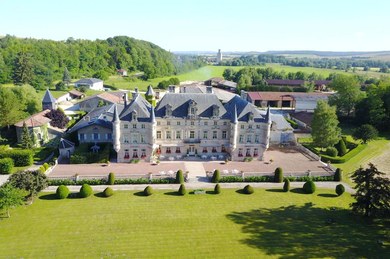
Château des Monthairons seen from the park, a pale château façade with four pointed towers, a balustrade and clipped shrubs
Photo: Havang(nl), CC0

Hostellerie du Château des Monthairons is at 26 route de Verdun in Les Monthairons and is recommended in the Michelin Guide.

It is on the Meuse, around 11 kilometres south of Verdun as the crow flies.

It is a family-run nineteenth-century château, with a 4-star hotel, 25 rooms and a spa.

The cooking is modern, and the price level is three euro signs.

In autumn 2026 it is open Tuesday–Saturday, from 21 October to 31 December. Michelin lists it as closed on Mondays, but the serving times are unclear, so confirm them when you book a table.

You will need a car, and you should book ahead.

RecommendedLes MonthaironsModernClosed on Mondays
See Château des Monthairons →
Nonsard · Recommended

La Mangeoire

Catamarans on the sandy beach at the Lac de Madine, with calm water and green headlands behind
Photo: Andre Corso, CC BY-SA 4.0

La Mangeoire is at 13 rue du Bois-Gérard in Nonsard-Lamarche by the Lac de Madine and is recommended in the Michelin Guide, which has also marked it as a ‘Coup de cœur’.

The restaurant is in a former farm, around 37 kilometres south-east of Verdun as the crow flies.

The chef, Quentin Pierre, uses produce from suppliers in the region, and the wine list includes wine from the Côtes de Meuse. The price level is two euro signs.

It is open on Wednesdays, Thursdays and Sundays from 12pm to 1.15pm and on Fridays and Saturdays from 12pm to 1.15pm and 7pm to 8.15pm, and closed on Mondays and Tuesdays.

The restaurant goes well with a day at the Lac de Madine and in Saint-Mihiel.

Michelin gives no season, so book ahead and check before you go.

RecommendedNonsardRegional produceClosed Mon–Tue
See La Mangeoire →
Quai de Londres · Bistro

Le Bistro d'Élo

The Quai de Londres in Verdun with pleasure boats in the green water, the quay wall, trees and a row of houses
Photo: Adam Jones from Kelowna, BC, Canada, CC BY 2.0

Le Bistro d'Élo is at 55 quai de Londres in Verdun, around 370 metres from the cathedral as the crow flies.

It is a bistro by the Meuse with a terrace, and the produce comes through short supply chains.

The restaurant is not in the Michelin Guide.

It is open Thursday–Saturday from 12pm to 1.30pm and 7pm to 8.30pm and on Sundays from 12pm to 1.30pm, and closed Monday–Wednesday.

In the evening a ‘bistronomic’ menu is served, according to Meuse Attractivité.

Book on 06 22 00 53 05, and check the times before you go.

Not in MichelinQuai de LondresBistroClosed Mon–Wed
See Le Bistro d'Élo →
Centre · Brasserie

La Brasserie d'Agnès

The Avenue de la Victoire in Verdun with trees on both sides and the Monument à la Victoire at the end of the street
Photo: Flocci Nivis, CC BY-SA 4.0

La Brasserie d'Agnès is at 4 avenue de la Victoire in Verdun, a short distance from the Monument à la Victoire and the Quai de Londres.

The brasserie used to be called Coq Hardi, serves traditional food and has a terrace with 200 outdoor seats.

The restaurant is not in the Michelin Guide.

It is open every day from 8am to 11.59pm from 1 April to 31 December 2026. The opening hours for 2027 have not been published.

The dish of the day costs €14, the formule from €14 and the menus €25–50 (2026).

Call 03 29 85 20 56 if there are several of you.

Not in MichelinAvenue de la VictoireTraditionalOpen every day (2026)
See La Brasserie d'Agnès →
Bras-sur-Meuse · On the way to the battlefield

L'Artaumarce

The town hall in Bras-sur-Meuse in pale stone and red brick, with flower boxes in the windows and two benches in front
Photo: Aimelaime~commonswiki, CC BY-SA 4.0

L'Artaumarce is at 8 avenue Raymond Poincaré in Bras-sur-Meuse, around 5.6 kilometres north of Verdun as the crow flies and on the road to Douaumont.

The cooking is traditional, and the restaurant has a veranda.

The restaurant is not in the Michelin Guide.

The full menu of the day costs €16.50 at lunch on weekdays (2026).

It is open Tuesday–Saturday from 12pm to 2pm and 7pm to 9.30pm, but not on Wednesday evenings, and on Sundays from 12pm to 2pm. It is closed on Mondays.

Book on 03 29 84 45 29, and check the times before you go.

Not in MichelinBras-sur-MeuseTraditionalClosed on Mondays
See L'Artaumarce →
Douaumont · Daytime only

L'Abri des Pèlerins

The Douaumont Ossuary behind rows of white crosses and red roses in the war cemetery
Photo: Adam Jones from Kelowna, BC, Canada, CC BY 2.0

L'Abri des Pèlerins is on the Place Monseigneur Ginisty in Douaumont-Vaux, 300 metres from the ossuary.

The brasserie is in a stone building from the late 1920s and is the only place to eat at the ossuary.

It is run by ADAPEI with employees with disabilities.

The restaurant is not in the Michelin Guide.

It is open from 10am to 6pm, closed on Wednesdays, from 23 January to 22 December 2026. There is no evening service. The times for 2027 have not been published.

Call 03 29 85 50 58 if there are several of you.

Not in MichelinBy the ossuaryDaytime 10am–6pmClosed on Wednesdays
See L'Abri des Pèlerins →
Battlefield · Ossuary and fort

Douaumont Ossuary and Fort de Douaumont

The war cemetery at Douaumont in summer, with rows of white crosses, and the Douaumont Ossuary with its tower on the left
Image from Frankrike.no.

The Douaumont Ossuary, around six kilometres north-east of Verdun as the crow flies, holds the remains of approx. 130,000 unknown French and German soldiers. The foundation stone was laid in 1920, and the ossuary was inaugurated on 7 August 1932. The cloister is 137 metres long, and the tower is 46 metres high.

The necropolis in front has 16,142 French graves according to Meuse Attractivité, including a Muslim section with 592 graves. The ossuary and the necropolis are part of the World Heritage Site ‘Funerary and memory sites of the First World War (Western Front)’, which was inscribed on 20 September 2023.

The ossuary requires decent dress, men without headwear, and silence. You must not eat, drink, smoke, take photographs or use a mobile phone, and animals are not allowed except guide dogs. The film and the tower cost €7, €3 for children aged 8–16 and €4.50 for students (2026). Allow approx. one hour.

Fort de Douaumont was begun in 1884, covers close to nine hectares and stands 388 metres above sea level. It was in German hands from 25 February to 24 October 1916. Inside the fort it is 12°C with wet floors, and only the upper level is wheelchair accessible. Allow approx. 1 hr 30 min.

The fort costs €8, €6.50 reduced, and the combined ticket for the Mémorial de Verdun and both forts €22, €17 reduced (2026). It is free for under-8s. In 2026 it was open from 9.30am to 5.30pm in the low season and from 9.30am to 6.30pm from 4 April to 20 September. It is closed on 24 and 25 December and 1 January 2027. The ossuary has its own times, and in January 2027 it is probably closed except on 2–3 January.

The Trench of Bayonets, the Tranchée des Baïonnettes, close by is a monument from 1920 over seven unknown soldiers. The story of soldiers who were buried standing up is a legend. Read more about the battle, the villages and the rules at the sites in the article.

Approx. 130,000 unknown16,142 gravesThe fort €8 (2026)Full day
Read the article →
Battlefield · Reopened July 2026

Fort de Vaux and Mémorial de Verdun

The grass-covered roof of Fort de Vaux in August, with a French flag on a stone base and a wide view towards the plain
Photo: Ludovic Péron, CC BY-SA 3.0

Fort de Vaux lies around 7.7 kilometres north-east of Verdun as the crow flies. The fort was built in 1881–1884, was besieged on 2–7 June 1916, and Commandant Raynal surrendered on 7 June. On 2–3 November 1916 it was retaken without a fight after the Germans had left it.

The fort reopened on 4–5 July 2026 with a new exhibition and sound through bone conduction, and you can hear about the carrier pigeon Vaillant. Allow approx. 1 hr 15 min. Dogs are not allowed. Tickets cost €8, €6.50 reduced (2026).

The Mémorial de Verdun in Fleury, five kilometres from the town, opened in 1967, was renovated in 2016 and has over 2,000 objects, VR headsets, a roof terrace and a café. Allow 1 hr 30 min. Tickets cost €14, €9 reduced (2026), and it is free for under-8s.

In 2026 both were open from 9.30am to 6.30pm from 4 April to 20 September and from 9.30am to 5.30pm for the rest of the season from 2 February to 31 December. Everything was closed from 3 January to 1 February 2026 and is closed on 24 and 25 December and 1 January 2027, and the museum also on 25 November 2026. The times and prices for 2027 have not been published. Parking is free.

Fleury-devant-Douaumont is one of nine villages that were wiped out and never rebuilt. It had 422 inhabitants in 1913 and changed hands 16 times in June–August 1916. There is free access to the site, with stones and signs where the houses stood.

Because of ash dieback several forest areas on the battlefield are closed or advised against (map as of 17 September 2026). Keep to waymarked paths, do not touch anything you find in the ground, and check the tourist office’s map. Read more in the article.

Vaux €8 (2026)Mémorial €14 (2026)Reopened July 2026Half day
Read the article →
Argonne · Meuse-Argonne 1918

Montfaucon, Romagne and Vauquois

The American monument in Montfaucon-d'Argonne in April, a tall white column with a figure on top, a wide flight of steps and leafless trees
Photo: Guido Radig, CC BY-SA 3.0

The Montfaucon American Monument, around 22 kilometres north-west of Verdun as the crow flies, commemorates the Meuse-Argonne Offensive from 26 September to 11 November 1918. The Doric granite column is approx. 60 metres, and there are 234 steps to the platform. It is open Monday–Friday from 9am to 4.45pm except on French and American public holidays, and it is free.

Read more about the memorial sites, the villages and the nature in our article on the Argonne and the Meuse valley, which also covers Saint-Mihiel and the lake.

The Meuse-Argonne American Cemetery in Romagne-sous-Montfaucon has 14,246 graves and the names of 954 missing. It is open daily from 9am to 5pm, with last admission at 4.45pm, and closed only on 25 December and 1 January. Entry is free, and there is no public transport there. It is one of the memorial sites on the UNESCO World Heritage List.

The Butte de Vauquois is a hill that was split in two by mine craters 10–20 metres deep. Close to 15,000 people died here, according to the association Les Amis de Vauquois. The surface has open access and is free all year. The galleries can only be seen with a guide, €5, €3 for children, and it is 13–14°C inside.

Guided tours of the galleries run on the first Sunday of the month in March–October from 9.30am, last tour before 3pm, on 1 and 8 May from 9.30am to 3.30pm, and in July and August on Tuesdays and Thursdays at 2pm by prior booking. The tour takes 2–3 hours. Wear closed shoes. Dogs are not allowed.

In Varennes-en-Argonne, around 26 kilometres west of Verdun, Louis XVI was stopped on the night of 21–22 June 1791. Seven signs follow the ‘Itinéraire Louis XVI’. The Musée d'Argonne is closed.

Approx. 22 kmMon–Fri 9am–4.45pm14,246 gravesFull day
Read the article →
Meuse valley · Art and lake

Saint-Mihiel and the Lac de Madine

Saint-Mihiel in June, with pleasure boats by the quay, houses with red roofs and a wooded ridge behind
Photo: Andre Corso, CC BY-SA 4.0

Saint-Mihiel is on the Meuse, around 32 kilometres south of Verdun as the crow flies. In the Église Saint-Étienne stands Ligier Richier’s ‘Sépulcre’ with 13 figures in limestone, and the abbey church has the ‘Pâmoison de la Vierge’ by the same artist and 80 choir stalls.

The Maison Ligier Richier, the house where the family lived in 1535–1564, is shown on request. The Bibliothèque bénédictine with 8,800 volumes is temporarily closed.

The Lac de Madine covers 1,100 hectares, with an 18-kilometre circuit and free admission. In 2026 there were lifeguards from 13 June to 20 September, at weekends and every day in July and August, and the dates for 2027 have not been published. Dogs are not allowed on the beach. The water park is from age 7 and cost €10 for one hour in 2026.

The Montsec American Monument, a circular colonnade on the Butte de Montsec, commemorates the fighting of 12–16 September 1918 and is free and always open. The fortified village of Hattonchâtel has a view, and in the Côtes de Meuse wine with IGP status is produced and mirabelles are grown.

Read more about Saint-Mihiel, the lake and the cycle route in our article on the Argonne and the Meuse valley, which also includes Vauquois, Montfaucon and Romagne.

Go by car or bike. La Meuse à vélo runs from Verdun to Saint-Mihiel in stages of 22 and 18 kilometres. Parking at the Lac de Madine is free. La Mangeoire is in Nonsard by the lake.

Approx. 32 km18 km circuitLifeguards June–September (2026)Full day
Read the article →