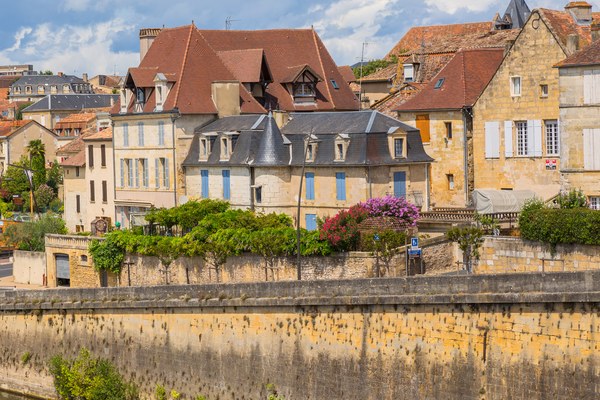
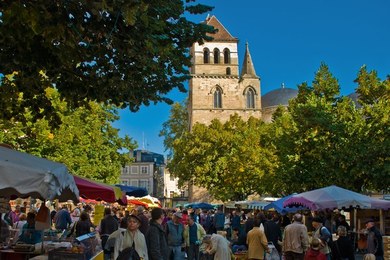
Bergerac grew up around an eleventh-century castle by the Dordogne, and Quai Salvette lies where the castle stood. From 1209 and for several hundred years, Bergerac was the only town in the whole Dordogne valley with a bridge.
Place Pélissière is named after the furriers who worked by the La Fonronde spring, and above the square stands the church of Saint-Jacques, a stage on the pilgrim route.
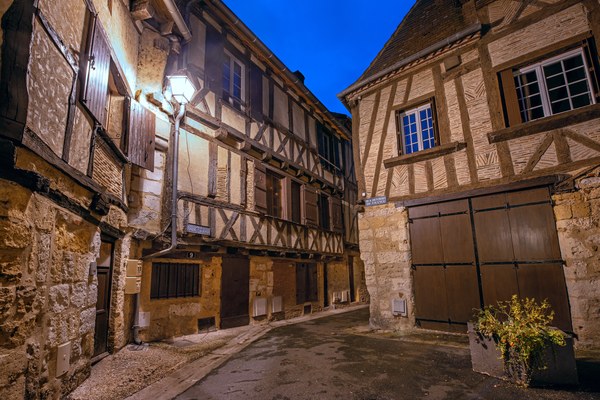
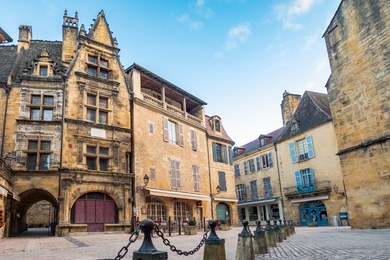
Place de la Myrpe has half-timbered houses and the old houses of the river boatmen, and in the rue de l'Ancien-Pont there are half-timbered houses from the sixteenth and seventeenth centuries.
In May 1577 Henry of Navarre, later Henry IV, negotiated the Peace of Bergerac in the Maison Doublet. From 1577 to 1661 the town was one of the strongest fortresses in the south-west, held by the Huguenots.
The Église Notre-Dame was completed in 1865 to designs by Paul Abadie, the architect of the Sacré-Cœur, and has two Renaissance paintings by Gaudenzio Ferrari and Pordenone.
The town map has three marked routes, and the town-centre route is 1.8 kilometres. Dordonha on the Place de la Petite-Mission has free exhibitions about the architecture and the history.
Eleventh-century castleNotre-Dame from 18651.8 km town routeFree all year