html Fontainebleau travel guide | The palace, the gardens and the forest | Frankrike.no Skip to content
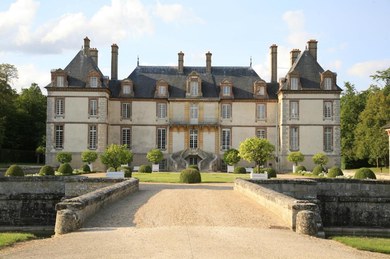
Montage of the palace of Fontainebleau and the Grand Parterre seen from the air, a sandstone boulder in the Gorges d'Apremont, Vaux-le-Vicomte and the Auberge Ganne in BarbizonSeine-et-Marne · Royal palace, forest and World Heritage
France travel guide

Fontainebleau

Fontainebleau is in Seine-et-Marne, around 55 kilometres south-east of Paris. The palace with its 1,500 rooms was rebuilt by François I from 1528, and Napoleon called it ‘la vraie demeure des rois’.

Around the town lies the forest with the sandstone boulders that made Fontainebleau famous for bouldering. The fires in July 2026 burned around 2,000 hectares, and parts of the forest and several climbing areas are still closed, so check with the ONF before you go.

The palace and the park were added to the UNESCO World Heritage List in 1981. The train from Paris Gare de Lyon takes around 40 minutes, and the town is a good base for Vaux-le-Vicomte, Barbizon, Moret-sur-Loing and Provins.

The palace and the gardensThe forest and the sandstoneVaux-le-Vicomte and Barbizon
Best forRoyal palace, World Heritage, free gardens and park, forest, bouldering on sandstone, cycling, painters’ villages and day trips to Vaux-le-Vicomte
Ideal forCouples, families, adults, history enthusiasts, walkers, boulderers, cyclists and anyone who wants a day trip from Paris
Easy to exploreThe palace, the gardens and the town centre on foot; trains from Paris Gare de Lyon in around 40 minutes; bus 3401 from the station and bus 3421 to Barbizon; cycle routes through the forest
Excellent base forBarbizon, Vaux-le-Vicomte and Melun, Samois-sur-Seine, Moret-sur-Loing and Provins
Highlights

Discover Fontainebleau

See the palace where Napoleon bade farewell to his Guard, walk in the free gardens and park, boulder on the sandstone in the forest and cycle to Barbizon. Check with the ONF first, as parts of the forest are closed after the fire.

Suggested itineraries

Fontainebleau in 1, 3 or 5 days

Choose how long you are staying, and combine the palace and the gardens with the forest, the bouldering and the day trips in the area.

A classic day in Fontainebleau

One day is enough for the palace, the gardens and the town centre, and a short walk into the forest if you start early.

MorningTake line R from Paris Gare de Lyon to Fontainebleau-Avon, around 40 minutes, and bus 3401 to the Château stop.
Late morningThe palace opens at 9.30am. Tickets cost €17 and give admission to the Grands Appartements and the Musée Napoléon Ier. Allow around two hours.
AfternoonHave lunch in the town centre, and walk in the Jardin de Diane, around the Étang aux Carpes and along the Grand Canal. The courtyards, the gardens and the park are free.
EveningHave dinner at L'Axel, which has one Michelin star, or at Fuumi, which has the same chef. Both are closed on Mondays.
Choose the right area

Where should you stay in Fontainebleau?

The choice is between the centre by the palace, the less expensive hotels in the centre, the town houses by the palace park, Barbizon on the edge of the forest and a château in Bourron-Marlotte. It decides the walking distance, the atmosphere and the price.

By the palace

The town centre

The 4-star Aigle Noir – MGallery is on the Place Napoléon-Bonaparte by the palace, and the 4-star Hôtel & Spa Napoléon is on the Rue Grande.

The shortest walk to the palace, the gardens and the market, and everything in the centre can be reached on foot.
Less expensive in the centre

Rue de Ferrare and Rue de France

The 3-star ibis Château de Fontainebleau is on the Rue de Ferrare, and the 3-star Hôtel Victoria is on the Rue de France, around 700 metres from the centre.

Suits anyone who wants to stay simply and walk to the palace, and bus 3401 runs from the station.
By the palace park

Rue d'Avon and Rue Royale

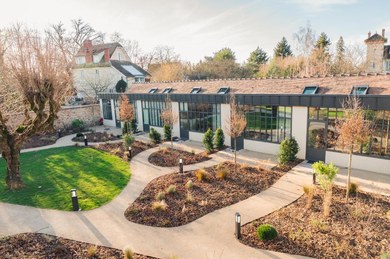
The 4-star Hôtel de Cavoye is a town house with a garden on the Rue d'Avon, and the 4-star Mercure Demeure de Campagne is on the Rue Royale at the western end of the town.

Quiet, with a short walk to the park and the edge of the forest.
The artists’ village

Barbizon

Barbizon is around 8 kilometres north-west of Fontainebleau, with L'Esquisse Hôtel Culturel, the Hôtellerie du Bas-Bréau and Les Pléiades, all with 4 stars.

Suits anyone who wants to stay on the edge of the forest near the museum, but you need a car or the bus.
A château on the edge of the forest

Bourron-Marlotte

The 3-star Château-Hôtel de Bourron is in a château in Bourron-Marlotte, around 7 kilometres south of Fontainebleau.

You need a car, but it suits anyone who wants to combine the forest with Moret-sur-Loing and the painters’ village of Marlotte.
Selected places to stay

Places to stay in and around Fontainebleau

Here are some of our selected places to stay in and around Fontainebleau, from 3 to 4 stars, in the centre, by the palace park and on the edge of the forest. Compare walking distance to the palace and the station.

Aigle Noir Fontainebleau – MGallery Collection in Fontainebleau★★★★
City centre

Aigle Noir Fontainebleau – MGallery Collection

A four-star hotel right opposite the château and the Jardin de Diane.

Hôtel & Spa Napoléon in Fontainebleau★★★★
City centre

Hôtel & Spa Napoléon

A four-star spa hotel on the main street, a couple of minutes from the château.

Demeures de Campagne Château de Fontainebleau in Fontainebleau★★★★
West of the centre

Demeures de Campagne Château de Fontainebleau

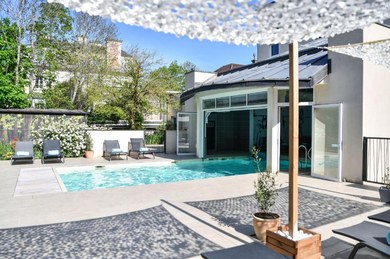
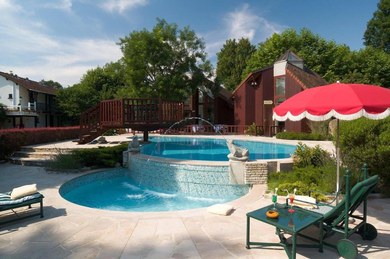
A large four-star hotel with a park and a pool at the west end of town.

The Originals Boutique, Hôtel Victoria in Fontainebleau★★★
City centre

The Originals Boutique, Hôtel Victoria

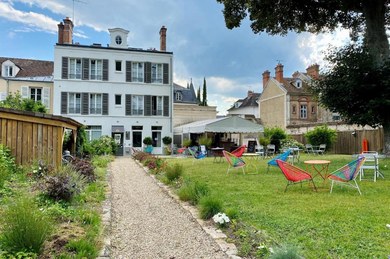
A three-star boutique hotel with a garden, within walking distance of the château.

The map shows our selected hotels in Fontainebleau and the villages around the forest. Click a marker for a photo and more information.
Camping and motorhomes

Camping near Fontainebleau

There is no classified campsite in Fontainebleau itself. The nearest are Le Lido in Moret-sur-Loing and Les Prés in Grez-sur-Loing, both with 3 stars. In the forest only the Grande Vallée bivouac site is open after the fire, for one night.

Forest, sandstone and cycle routes

The landscape around Fontainebleau

The forest by bike

The cycle routes

The cycle routes to Barbizon, Samois and Bois-le-Roi are open after the fire. For more routes, see our guide to cycling in France.

Forêt d'Exception since 2013

The state forest

The state forest is managed by the ONF and covers around 22,000 hectares. The painters won protection for over 600 hectares in 1853, and in 2013 it became the first Forêt d'Exception.

Châteaux around Paris

Fontainebleau and Vaux

The palace and Vaux-le-Vicomte are two of the châteaux around Paris. Read more in our guide to France’s castles, where both are included.

Car hire from Paris-Orly

A car for your day trips

Paris-Orly (ORY) is about 44 km from Fontainebleau as the crow flies. With your own car you can more easily reach Vaux-le-Vicomte, Moret-sur-Loing and Provins.

Châteaux, painters’ towns and the Middle Ages

Four good day trips from Fontainebleau

Fontainebleau lies in the middle of the forest south-east of Paris. To the north is Vaux-le-Vicomte in Maincy near Melun, to the north-west the artists’ village of Barbizon on the edge of the forest, to the south-east Moret-sur-Loing, and further east the medieval town of Provins.

Continue your journey

More destinations from Fontainebleau

Fontainebleau fits into a trip around Île-de-France and further east, with Paris to the north, Auxerre to the south-east and Épernay to the north-east.

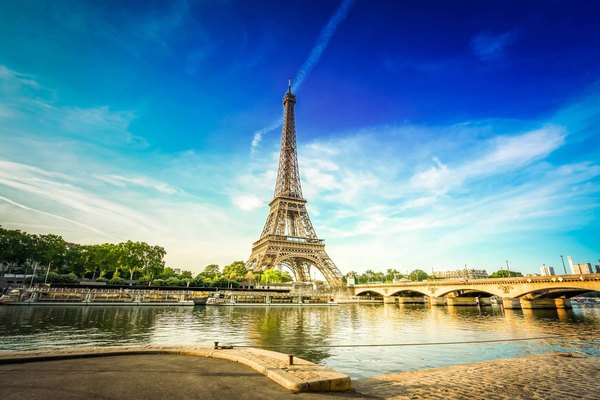
The Eiffel Tower above the Seine seen from the quay in Paris, with the Pont d'Iéna
The capital

Paris

Take line R to Paris Gare de Lyon in around 40 minutes, and combine Fontainebleau with the museums and districts of Paris.

Open the Paris guide →
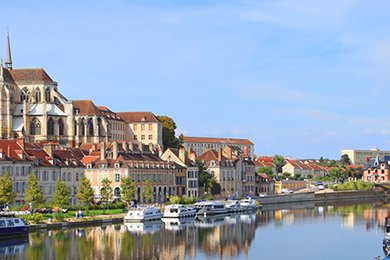
Auxerre seen from the Yonne with the bell tower of Saint-Germain, the cathedral and the houses along the quay
The town on the Yonne

Auxerre

Travel on south-east to the cathedral and the old town of Auxerre, around 93 kilometres away as the crow flies.

Open the Auxerre guide →
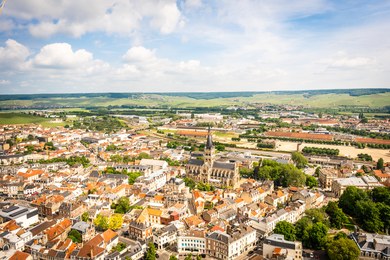
Épernay from above with the orange roofs, the church of Notre-Dame and the vineyard slopes of the Marne valley
The champagne town

Épernay

Continue north-east to the champagne houses of Épernay, around 116 kilometres from Fontainebleau as the crow flies.

Open the Épernay guide →
Read more

Read our inspiring articles about France

Find inspiration in travel guides, touring itineraries and personal tips from across France. Discover cities, villages, food and wine experiences, nature and new destinations.

Palace · World Heritage since 1981

Château de Fontainebleau

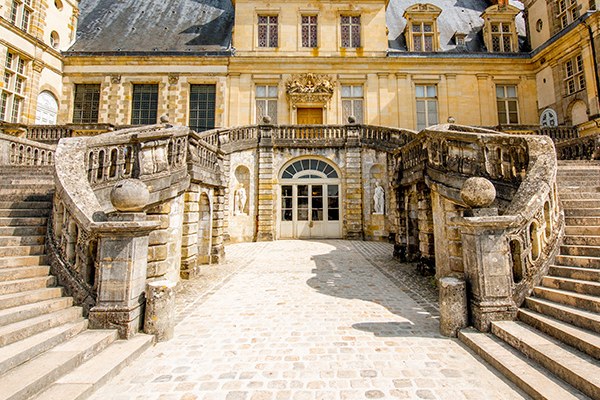
The horseshoe staircase in front of the main wing in the Cour des Adieux at the palace of Fontainebleau
Image from Frankrike.no.

From 1528 François I had the medieval castle rebuilt in the Italian style, and artists such as Rosso Fiorentino and Primaticcio brought the Renaissance here. Napoleon called the palace ‘la maison des siècles’.

Louis XIII was born here, and Pope Pius VII was held prisoner in the palace in 1812–1814. Napoleon abdicated here on 4 and 6 April 1814 and bade farewell to the Old Guard by the horseshoe staircase on 20 April.

The palace is open from 9.30am to 6pm from April to September and from 9.30am to 5pm from October to March, with last admission 45 minutes before closing. It is closed on Tuesdays, 1 January, 1 May and 25 December.

Tickets cost €17, reduced €15, and give admission to the Grands Appartements and the Musée Napoléon Ier. Under-18s go free, as do 18–25-year-olds who have lived in the EU for more than six months.

The Petits Appartements, the Boudoir Turc, the Musée chinois and the Théâtre de Napoléon III can only be seen on a guided tour, which costs €7 extra. Tours run in French all year and in English only in summer.

On the first Sunday of the month it is free for everyone, except in July and August. Allow around two hours, and start before 3pm in summer and 2pm in winter, as the rooms close gradually.

World Heritage 1981€17, free under 18Closed TuesdaysApprox. 2 hours
See opening times and tickets →
Park · Free every day

The park and the gardens

The wings of the palace reflected in the Étang aux Carpes on a clear day, with the trees of the park to the left
Photo: Jean-Christophe BENOIST, CC BY 3.0

The palace has 130 hectares of park and gardens. The 14-hectare Grand Parterre was laid out in 1660–1664 by André Le Nôtre and Louis Le Vau, and the palace calls it the largest in Europe.

The article on the Fontainebleau forest tells you about the trails, the bouldering and the areas that are closed after the fire.

The Étang aux Carpes is a 6-hectare pond with a pavilion that Louis Le Vau built in 1662. The Grand Canal from the time of Henri IV, 1606–1609, is around 1,200 metres long and 40 metres wide.

The Jardin de Diane is named after the fountain with Diana the huntress, the only one of Henri IV’s fountains to survive. The Jardin anglais was laid out in 1810–1812.

The courtyards and the gardens are free and open every day, including Tuesdays: from 9am to 5pm from November to February, from 9am to 6pm in March, April and October and from 9am to 7pm from May to September. The park is open around the clock.

Picnics are allowed on the lawns in the Jardin anglais and in the park. Dogs are not allowed in the courtyards and the gardens, but are allowed on a lead in the park around the Grand Canal.

130 hectaresFreeOpen on Tuesdays tooLe Nôtre 1660–1664
See the gardens on the palace’s website →
State forest · Forêt d'Exception

Forêt de Fontainebleau

A round sandstone boulder on a rock slab in the Gorges de Franchard, with pine forest around it
Photo: Rémih, CC BY-SA 4.0

The massif covers around 22,000 hectares with three state forests, Fontainebleau, Trois-Pignons and La Commanderie, managed by the ONF. It is not a national park, but Fontainebleau was the first forest with the Forêt d'Exception label, in 2013.

Claude-François Denecourt created the first waymarked trails, the blue trails, in 1842. Today there are several hundred kilometres of waymarked trails, and the Tour Denecourt, with views all around, is just above the station.

The fires on 12 and 13 July 2026 burned around 2,000 hectares in Trois-Pignons and by the Faisanderie. Apremont, the Faisanderie to the Route Ronde, Haute-Borne and southern Trois-Pignons are closed, and blue trail no. 8 and the Circuit des 25 bosses are completely closed.

Closed areas are marked with wooden barriers and signs, and trees can fall long after the fire. Check the ONF map of open and closed areas before you go.

Campfires and barbecues are forbidden, and you must not throw away cigarettes. Wear long clothes against ticks, and expect poor mobile coverage in parts of the forest.

Bivouacking is only allowed at the official sites, and after the fire only Grande Vallée is open, for one night.

Approx. 22,000 hectaresBlue trails from 1842Partly closedCheck with the ONF
Read the article →
Bouldering · Without ropes

Bouldering on sandstone

Two boulderers by a large sandstone boulder, one climbing and the other standing on the crash pad
Photo: Jerome Bon from Paris, France, CC BY 2.0

The tourist office calls Fontainebleau the birthplace of bouldering, with over 30,000 boulders, 270 sectors and 280 circuits. You climb without ropes, at low height and with a crash pad.

The circuits are marked with colours: white for children, yellow for beginners, then orange, blue, red and black for the hardest. The arrows on the boulders are numbered.

The ONF asks climbers to use little chalk and pof and to wipe the rock with a cloth afterwards. Metal and nylon brushes are forbidden.

Do not climb on wet rock, lift the crash pad when you move it, and only climb at the authorised sites.

As of October 2026, 18 areas in Trois-Pignons are completely closed after the fire, among them Bois Rond, Roche aux Sabots and Cul de Chien. Bas Cuvier, Franchard Isatis, Rocher Canon and Éléphant near Larchant are open, but check with the ONF before you go.

Bas Cuvier is by the Carrefour de l'Épine just before Barbizon, and from the bus to Barbizon you walk 20–25 minutes.

Over 30,000 bouldersWithout ropesLittle chalkCheck with the ONF
Read the article →
Town · Market three days a week

The town centre and the market

Outdoor tables under red parasols on the Place Napoléon-Bonaparte in Fontainebleau
Photo: Baidax, CC BY-SA 4.0

The centre is right by the palace, with the Place Napoléon-Bonaparte, the Rue Grande and the Rue de France.

The market on the Place de la République is open on Tuesday, Friday and Sunday mornings, with over 100 traders on 4,500 square metres.

It was awarded the Marché d'Exception distinction in 1996.

The Fontainebleau Tourisme tourist office is at 4 bis Place de la République, by the market.

The Fontainebleau-Avon station is 2.3 kilometres away, and bus 3401 runs to the Château stop.

L'Axel, Fuumi and L'Orée des Sablons are all in the centre, within walking distance of the palace.

Market Tue, Fri, SunOver 100 tradersBus 3401On foot
See the town centre at the tourist office →
Village · On the Seine

Samois-sur-Seine and Django Reinhardt

Houses and villas along the Seine at Samois-sur-Seine, reflected in the still water
Photo: Myrabella, CC BY-SA 3.0

Samois-sur-Seine is on the Seine, around 6.5 kilometres north-east of Fontainebleau as the crow flies.

The jazz guitarist Django Reinhardt died in Samois in May 1953 and is buried in the cemetery there, together with his brother Joseph.

The Festival Django Reinhardt started in Samois in 1968, but today it is held in the palace park in Fontainebleau.

The dates of the 2027 festival have not been announced, so check the festival’s website before you plan your trip.

The Fontainebleau–Samois cycle route through the forest is open after the fire.

Samois has no classified hotels, so stay in Fontainebleau instead.

Approx. 6.5 kmDjango died 1953Festival in the palace parkCycle route through the forest
See Samois on the commune’s website →
Fontainebleau · One star

L'Axel

The Rue de France in Fontainebleau with town houses, shutters and wrought-iron balconies
Photo: dflegmatic, CC BY 2.0

L'Axel is on the Rue de France in Fontainebleau and holds one star in the Michelin Guide.

The Japanese head chef Kunihisa Goto gives French classics a new twist with seasonal produce and Japanese ingredients, and ‘the perfect egg’ is a signature dish.

Michelin describes the restaurant as simple and elegant, with attentive service. The price level is four euro signs.

The restaurant is closed on Mondays and Tuesdays, serves dinner only on Wednesdays and has lunch and dinner Thursday–Sunday.

The Rue de France is in the centre, a few hundred metres from the palace.

Book well ahead, especially for dinner at weekends.

One starRue de FranceFrench and JapaneseClosed Mon–Tue
See L'Axel →
Fontainebleau · Recommended

Fuumi

The Église Saint-Louis in Fontainebleau with the bell tower and the pale stone façade
Photo: Baidax, CC BY-SA 4.0

Fuumi is on the Rue de France in Fontainebleau and is recommended in the Michelin Guide.

It is the second restaurant of Kunihisa Goto, the chef at L'Axel, which is a few doors away.

The cooking is Japanese, with gyoza, ramen and okonomiyaki made in front of the guests, and the lunch bento is inexpensive. The price level is two euro signs.

At the counter you can watch the chefs cook.

Fuumi is open Tuesday–Saturday from 12pm to 2pm and 7pm to 10pm, and closed on Sundays and Mondays.

It is often full, so book a table.

RecommendedRue de FranceJapanese cookingClosed Sun–Mon
See Fuumi →
Fontainebleau · Recommended

L'Orée des Sablons

The pedestrian Rue des Sablons in Fontainebleau with cobblestones, town houses and shops
Photo: dflegmatic, CC BY 2.0

L'Orée des Sablons is on the Rue des Sablons, a pedestrian street in Fontainebleau, and is recommended in the Michelin Guide.

The chef has been a finalist in the lièvre à la royale championship and makes pâté en croûte.

Michelin describes traditional cooking with a meat-focused menu, good desserts and friendly service. The price level is two euro signs.

The restaurant is open Tuesday–Saturday from 10am and closed on Sundays and Mondays.

It is in the heart of the centre, a couple of hundred metres from the palace.

Book ahead, especially at weekends.

RecommendedPedestrian street in the centreTraditional cookingClosed Sun–Mon
See L'Orée des Sablons →
Melun · Recommended

La Bodega

The Gothic church of Saint-Aspais in Melun seen from a cobbled street corner
Photo: Baidax, CC BY-SA 4.0

La Bodega is on the Quai Hippolyte-Rossignol in Melun and is recommended in the Michelin Guide.

The cooking is Spanish, especially from Asturias, where the family comes from, with Iberian pork, paella and grilled octopus.

The price level is two euro signs.

The restaurant is closed on Sundays, serves lunch only on Mondays and dinner only on Saturdays.

Melun is around 15 kilometres north of Fontainebleau as the crow flies, and Vaux-le-Vicomte is around 6 kilometres from the restaurant.

Combine dinner with a day at Vaux-le-Vicomte.

RecommendedMelunSpanish cookingApprox. 15 km
See La Bodega →
Milly-la-Forêt · Recommended

Les Coqs

The fifteenth-century market hall in Milly-la-Forêt with its steep tiled roof
Photo: GFreihalter, CC BY-SA 3.0

Les Coqs is on the Place du Marché in Milly-la-Forêt and is recommended in the Michelin Guide, with the Coup de cœur label.

The restaurant is in a former antiques shop with a glass roof and a terrace in a patio.

The head chef Émilien Le Normand makes modern dishes on a classic foundation, and the price level is two euro signs.

Milly-la-Forêt is in Essonne, around 17 kilometres west of Fontainebleau as the crow flies, on the western side of the forest.

The restaurant is closed on Tuesdays and Wednesdays, and on Thursdays only dinner is served.

Book ahead, especially at weekends.

RecommendedMilly-la-ForêtModern cookingApprox. 17 km
See Les Coqs →
Corbeil-Essonnes · Recommended

Aux Armes de France

The Seine in Corbeil-Essonnes in the evening light, with the houses on the opposite bank
Photo: poudou99, CC BY-SA 4.0

Aux Armes de France is on the Boulevard Jean-Jaurès in Corbeil-Essonnes and is recommended in the Michelin Guide.

The restaurant is in a former coaching inn with a bright dining room.

The head chef Yohann Giraud makes modern dishes with classic roots, such as stuffed macaroni with foie gras and a Grand Marnier soufflé. The price level is three euro signs.

Corbeil-Essonnes is in Essonne, around 28 kilometres north-west of Fontainebleau as the crow flies.

The restaurant is open Tuesday–Saturday, on Wednesdays for lunch only, and closed on Sundays and Mondays.

Book ahead, especially for dinner at weekends.

RecommendedCorbeil-EssonnesModern cookingApprox. 28 km
See Aux Armes de France →
Château · Maincy near Melun

Vaux-le-Vicomte

The Château de Vaux-le-Vicomte with its dome and the box parterre de broderie in the foreground
Image from Frankrike.no.

Vaux-le-Vicomte is in Maincy near Melun, around 18 kilometres north of Fontainebleau as the crow flies, and has always been privately owned.

Nicolas Fouquet, Louis XIV’s finance minister, began building in 1653 with the architect Louis Le Vau, the painter Charles Le Brun and the gardener André Le Nôtre, who worked together here for the first time.

After the party for the king on 17 August 1661, Fouquet was arrested in Nantes on 5 September by d'Artagnan, and he died in captivity in 1680.

In 2026 the château was open from 14 March to 1 November, from 10am to 5.30pm, and a ticket for the château and garden cost €18. Under-6s go free, and parking is free.

On Saturdays from 16 May to 26 September 2026 there were candlelit evenings with fountains. Christmas at Vaux runs from 14 November 2026 to 3 January 2027, when tickets must be booked online. The candlelit evenings for 2027 have not been published.

The château gives no train connection, so drive, or take the train to Melun and a bike or taxi for the last stretch.

Maincy near Melun€18 in 2026Le Nôtre and Le VauFull day
Read the article →
Artists’ village · Edge of the forest

Barbizon

The Auberge Ganne with vines and white shutters on the main street in Barbizon
Photo: Morio60, CC BY-SA 2.0

Barbizon is on the edge of the forest, around 8 kilometres north-west of Fontainebleau as the crow flies, and bus 3421 runs there from Fontainebleau-Avon.

From the 1820s the painters stayed at the Auberge Ganne inn, and Théodore Rousseau settled here for good in 1847. The collection includes works by Corot, Millet, Rousseau and Diaz.

The Musée départemental des peintres de Barbizon has two houses: the Auberge Ganne and Théodore Rousseau’s studio house.

The museum is open every day except Tuesdays from 10am to 12.30pm and 2pm to 5.30pm, and until 6pm from April to October. Tickets cost €8, and under-25s go free.

After pressure from the painters, over 600 hectares of the forest were protected as artistic reserves in 1853.

Millet’s studio on the same street is not part of the museum. By bike it is around 11 kilometres from the station at Fontainebleau-Avon.

Approx. 8 kmMuseum €8Closed TuesdaysBus 3421
Read the article →
Medieval town · Sisley

Moret-sur-Loing

The bridge over the Loing in Moret-sur-Loing with the Porte de Bourgogne and the church of Notre-Dame behind
Photo: Dvillafruela, CC BY 3.0

Moret-sur-Loing is around 9 kilometres south-east of Fontainebleau as the crow flies and is today part of the commune of Moret-Loing-et-Orvanne.

Read more about the painters in the forest and the artists’ village of Barbizon in our article on Vaux-le-Vicomte and Barbizon, which also tells the story of Nicolas Fouquet.

Alfred Sisley lived for around 20 years in Veneux-Nadon and Moret until he died in 1899, and painted over 400 canvases in the area.

The Sisley trail, Sur les traces de Sisley, is 7 kilometres long, with plaques at the places where he painted in Moret, Saint-Mammès and Veneux-Les Sablons.

The town was a border fortress facing Burgundy, with 1,356 metres of town walls and the Porte de Samois and Porte de Bourgogne gates. Nicolas Fouquet was held prisoner in the keep in 1664.

The keep is private, and the Porte de Bourgogne is only open during the Journées du Patrimoine.

Approx. 9 kmSisley trail 7 kmTown walls 1,356 mHalf day
See Moret at the tourist office →
Medieval town · World Heritage

Provins

The Tour César on the hill in Provins with its corner turrets and the dome of Saint-Quiriace on the right
Photo: Jean-Pol GRANDMONT, CC BY 4.0

Provins is around 47 kilometres east of Fontainebleau and has been on the UNESCO World Heritage List since 2001 as a medieval fair town.

The town was one of the fair towns of the Counts of Champagne, and its fairs in the twelfth and thirteenth centuries were among the most important in Europe. There are 58 protected monuments.

The Tour César is a twelfth-century tower. In 2026 it was open every day from 10am to 6pm from 28 March to 1 November, and tickets cost €5. The €17 Pass Provins gives admission to five monuments.

Of the town walls from the eleventh to thirteenth centuries, 1.2 kilometres remain around the Ville Haute, and the Les Médiévales medieval festival was on 13–14 June in 2026.

If you want to see more châteaux and gardens, read our article on Vaux-le-Vicomte and Barbizon, another day trip from Fontainebleau.

There are no direct trains from Fontainebleau. Trains to Provins run from Paris Est on line P, so a car is easiest from here.

World Heritage 2001Tour César €5Approx. 47 kmFull day
See Provins at the tourist office →