html Saint-Émilion travel guide | Monolithic church, wine châteaux and World Heritage | Frankrike.no Skip to content
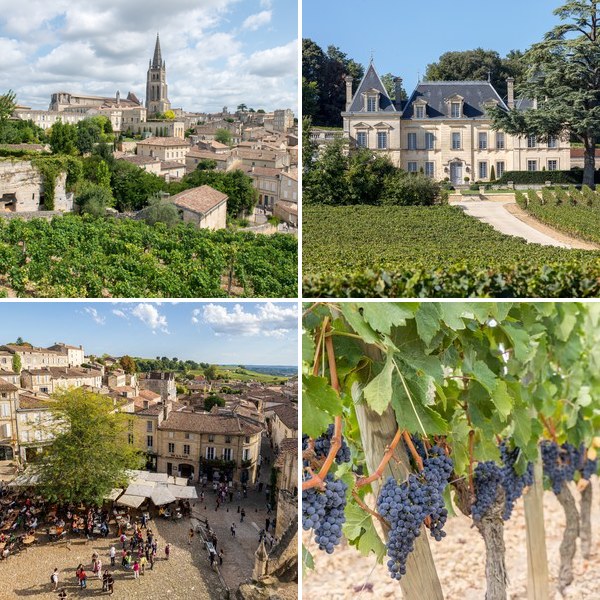
Montage of Saint-Émilion above the vineyards, a wine château with a cedar, the square by the monolithic church and Merlot grapesGironde · Wine village, monolithic church and World Heritage
France travel guide

Saint-Émilion

Saint-Émilion is the medieval village on the limestone plateau east of Bordeaux, with steep cobbled lanes, 14 historic monuments and the vineyards just outside. Around a million visitors come here every year.

The monolithic church was carved out of the limestone early in the twelfth century, and beneath the village run almost 200 kilometres of passages left by the old quarries. The church can only be seen with a guide, and tickets are sold by the tourist office.

The surrounding vineyards were added to the UNESCO World Heritage List in 1999, according to the tourist office as the first vineyard landscape. Saint-Émilion is also a good base for Pomerol, Libourne, the bastides of Entre-deux-Mers and the abbey ruins of La Sauve-Majeure.

The monolithic church and the undergroundWine tasting and macaronsThe wine châteaux and the World Heritage Site
Best forWine, wine châteaux, underground monuments, medieval history, food, cycling in the vineyards and day trips in Entre-deux-Mers
Ideal forCouples, adults, wine lovers, food lovers, cyclists and anyone on a tour of south-west France with Bordeaux and the Dordogne
Easy to exploreThe village, the monolithic church, the Tour du Roy and the Maison du Vin on foot; the wine châteaux by car, bike or organised tour; Bordeaux by regional train
Excellent base forPomerol, Libourne, Montagne and the satellite appellations, the bastides of Entre-deux-Mers, La Sauve-Majeure and Cadillac-sur-Garonne
Highlights

Discover Saint-Émilion

Go underground to the monolithic church, visit the wine châteaux in the World Heritage landscape, taste wine at the Maison du Vin, see the Cordeliers cloister and climb the Tour du Roy for the view over the vineyards.

Suggested itineraries

Saint-Émilion in 1, 3 or 5 days

Choose how long you are staying and combine the village, the underground and the wine châteaux without spending unnecessary time in the car.

A classic day in Saint-Émilion

One day is enough for the underground tour, a tower with a view, the Maison du Vin and a wine château just outside the village.

MorningArrive early to find parking, and start with the underground tour from the Place de l’Église Monolithe. It takes 45 minutes to an hour.
Late morningClimb the bell tower or the Tour du Roy for the view, and take the wine school at the Maison du Vin at eleven.
AfternoonHave lunch in the village, and visit a wine château that welcomes guests. Book the tour in advance.
EveningWalk down the steep lanes and steps, and have dinner at one of the restaurants in the village.
Choose the right area

Where should you stay in Saint-Émilion?

The choice is between staying in the medieval village, just outside it, at a wine château in the vineyards, in Libourne or in the villages north of Saint-Émilion. It decides the atmosphere, the parking and the price.

The medieval village

Inside the village

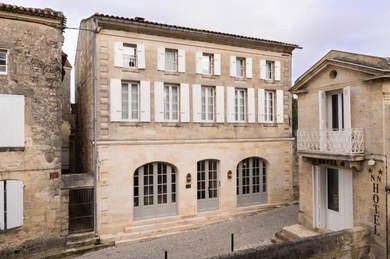
Inside the town wall are small hotels in old stone houses, from the five-star Hôtel de Pavie right above the monolithic church to hotels with only a few rooms by the Porte Brunet and the Porte Bouqueyre.

The most atmosphere and everything within walking distance, but the streets are steep and parking spaces are few.
Vineyards and pools

Just outside the village

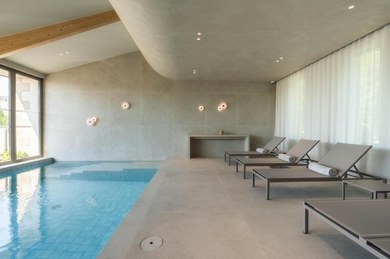
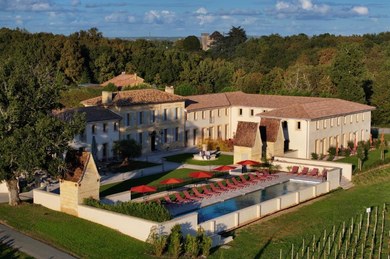
Just outside the medieval village are newer hotels among the vines, such as La Villa des Vignes with a heated indoor pool, around 200 metres from the centre.

A good balance between walking distance to the village and easy arrival by car.
Châteaux and spa

Wine châteaux with hotels

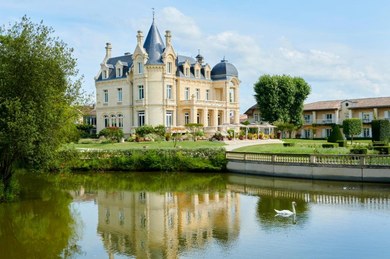
Château Grand Barrail on the road to Libourne is a nineteenth-century château with a park, a spa and an outdoor pool, and Château Fage in Arveyres lies between Saint-Émilion and Entre-deux-Mers.

You need a car, but you get the vineyards right outside the door and peace in the evening.
River and train

Libourne

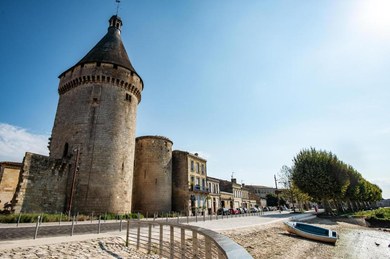
The bastide where the Isle meets the Dordogne, 7 kilometres from Saint-Émilion, has hotels on the riverside quay, close to the station and the vineyards of Pomerol.

Suits anyone arriving by train, or anyone who wants to combine the wine châteaux with Pomerol and the market in Libourne.
The satellite appellations

Montagne and Puisseguin

North of Saint-Émilion are the Aux Ducs de Sienne hotel in the village of Montagne, near the Moulins de Calon windmills, and the Fleur de Roques château hotel in the vineyards of Puisseguin.

You need a car, but you get a quieter base among the vineyards of the satellite appellations.
Selected places to stay

Places to stay in Saint-Émilion

Here are some of our selected places to stay in and around Saint-Émilion, from 2 to 5 stars, in the medieval village, at wine châteaux in the vineyards and in Libourne. Compare spas, pools, parking and walking distance to the monolithic church.

Hôtel de Pavie in Saint-Émilion★★★★★
Above the monolithic church, in the village

Hôtel de Pavie

The only five-star hotel in the village, right above the monolithic church.

Château Hôtel Grand Barrail in Saint-Émilion★★★★★
A château in the vineyards towards Libourne

Château Hôtel Grand Barrail

Five-star 19th-century château hotel with a park, spa and pool among the vines.

Logis de la Cadène in Saint-Émilion★★★★
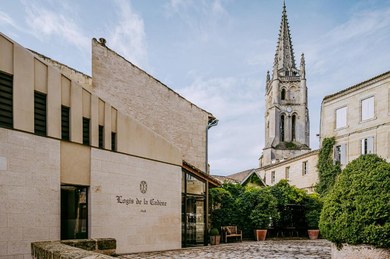
In a steep lane in the medieval village

Logis de la Cadène

Small four-star boutique hotel with its own Michelin star.

La Villa des Vignes in Saint-Émilion★★★★
Among the vines just outside the village

La Villa des Vignes

New four-star boutique hotel with an indoor pool and terraces facing the vines.

Hôtel Porte Brunet in Saint-Émilion★★★★
By the Porte Brunet, east of the village

Hôtel Porte Brunet

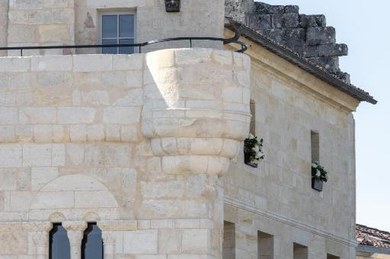
Four-star hotel with six rooms by the best-preserved medieval gate.

Hôtel Château Fage in Saint-Émilion★★★★
A wine château south of the Dordogne

Hôtel Château Fage

Four-star hotel on a wine estate between Saint-Émilion and Entre-deux-Mers.

Auberge de la Commanderie in Saint-Émilion★★★
At the top of the medieval village

Auberge de la Commanderie

Family-run three-star hotel with views over the monuments and vineyards.

Hôtel Au Logis des Remparts in Saint-Émilion★★★
Along the town wall on rue Guadet

Hôtel Au Logis des Remparts

Three-star hotel along the town wall on rue Guadet, by the macaron bakery.

Logis Hôtel de la Tour in Saint-Émilion★★★
On the riverside quay in Libourne

Logis Hôtel de la Tour

Small three-star hotel on the riverside quay in Libourne, near the station.

The map shows our nine selected hotels in Saint-Émilion, in the surrounding vineyards and in Libourne. Click a marker for a photo and more information.
Camping and motorhomes

Camping in and around Saint-Émilion

The map gives priority to campsites with their own website around Saint-Émilion, in the satellite appellations and in Entre-deux-Mers. Yelloh! Village Saint-Émilion has four stars and lies around one kilometre from the village. Motorhomes must park outside the village.

Vineyards, World Heritage and cycle paths

The landscape around Saint-Émilion

Vineyards by bike

Circular routes and La Scandibérique

Cycle or walk one of the 30 circular routes through the vineyards, or find more routes in our guide to cycling in France.

World Heritage since 1999

The Jurisdiction of Saint-Émilion

The first vineyard landscape on the World Heritage List: 7,847 hectares in eight municipalities between the Dordogne and the Barbanne.

Wine châteaux and appellations

Saint-Émilion and Pomerol

Follow the small roads between the wine châteaux and taste Bordeaux wine, mostly Merlot with Cabernet Franc.

Car hire from Bordeaux Airport

A car for your day trips

Bordeaux Airport (BOD) is about 45 km from Saint-Émilion as the crow flies. With your own car you can also reach places that are awkward to get to by train and bus.

Wine, bastides and abbeys

Four good day trips from Saint-Émilion

Saint-Émilion lies north of the Dordogne, with Pomerol and Libourne just west of the village. South of the river lies Entre-deux-Mers, the land between the Garonne and the Dordogne, with bastides, the abbey ruins at La Sauve and the château in Cadillac-sur-Garonne.

Continue your journey

More destinations from Saint-Émilion

Saint-Émilion fits naturally into a tour of south-west France, with Bordeaux to the west, Arcachon on the coast and Sarlat in the Périgord Noir further east.

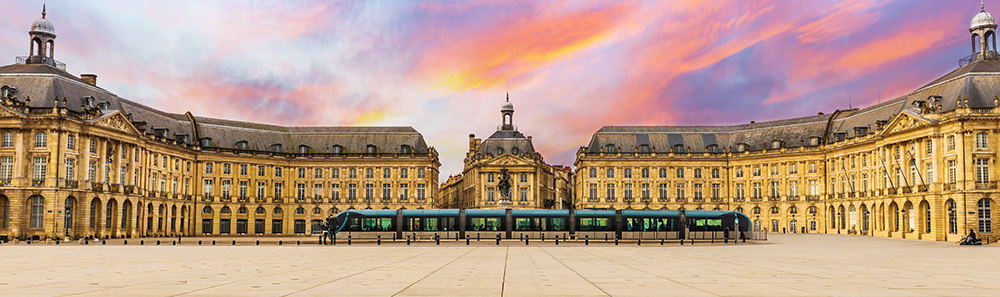
Bordeaux with elegant streets by the Garonne
The wine city on the Garonne

Bordeaux

Combine Saint-Émilion with the architecture along the Garonne and the wine city of Bordeaux, around half an hour away by regional train.

Open the Bordeaux guide →
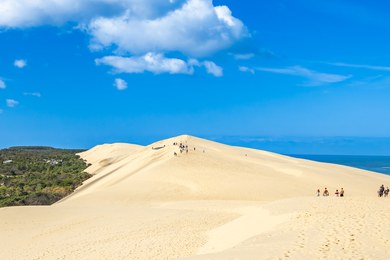
The Dune du Pilat with the pine forest on one side and the sea on the other
Europe’s highest sand dune

Arcachon

Travel via Bordeaux to the Dune du Pilat, the oyster harbours and the boat trips to Cap Ferret, and taste oysters with white wine from Entre-deux-Mers.

Open the Arcachon guide →
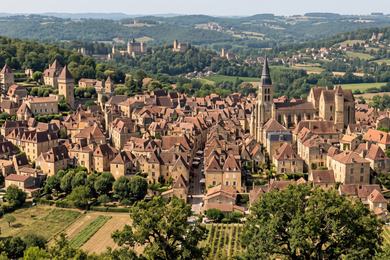
A narrow street with stone houses in the old town of Sarlat
The medieval town in the Périgord Noir

Sarlat

Take the regional train east on the same Bordeaux–Sarlat line that stops in Saint-Émilion, to the old town and the castles along the Dordogne.

Open the Sarlat guide →
Read more

Read our inspiring articles about France

Find inspiration in travel guides, touring itineraries and personal tips from across France. Discover cities, villages, food and wine experiences, nature and new destinations.

Underground · Twelfth century

The monolithic church and the underground

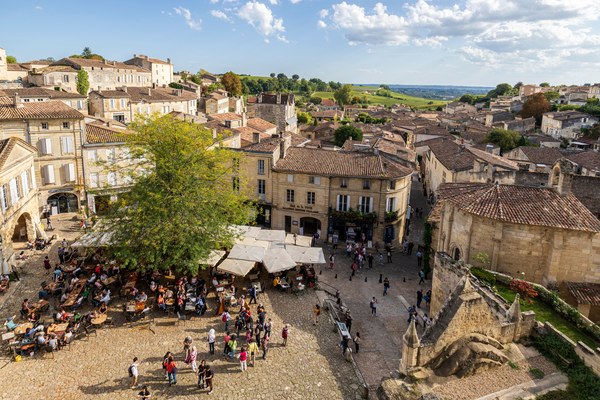
The Place de l’Église Monolithe seen from above, with the cafés on the square
Image from Frankrike.no.

The monolithic church was carved out of the limestone early in the twelfth century, and the tourist office calls it the largest monolithic church in Europe.

The Saint-Émilion Souterrain tour takes you to four monuments: the hermitage cave, the Trinité chapel with medieval paintings, the catacombs and the church itself.

The monk Émilion from Vannes in Brittany settled in a cave here in the eighth century, and the spring he is said to have made flow today feeds the two nineteenth-century wash houses.

The church can only be visited with a guide, and the tour takes 45 minutes to an hour. It runs in French and English, and you can get written translations in several languages at the tourist office. Photography is not allowed underground.

Tickets cost €15 for adults in 2026, €12 reduced and €8 for children aged 6 to 17. Children under six go free but need a ticket.

Buy your ticket at the tourist office or online, and meet on the Place de l’Église Monolithe at the time on your ticket. Latecomers are not admitted. Bring a jumper, as it is around 13 degrees underground.

Twelfth centuryGuided tours only€15 in 2026On foot
Buy tickets from the tourist office →
Wine châteaux · World Heritage since 1999

The wine châteaux and the World Heritage Site

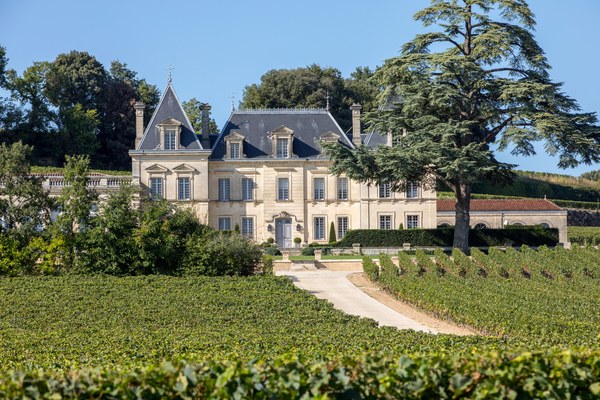
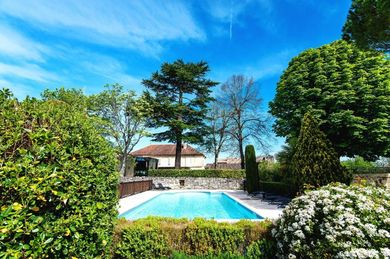
A wine château with a cedar in the vineyards near Saint-Émilion
Image from Frankrike.no.

The Jurisdiction of Saint-Émilion was added to the UNESCO World Heritage List on 2 December 1999, according to the tourist office as the first vineyard landscape.

The World Heritage landscape covers 7,847 hectares in eight municipalities, from the Dordogne in the south to the Barbanne stream in the north.

Under the 2022 classification, only Château Pavie and Château Figeac are Premier Grand Cru Classé A. Ausone, Cheval Blanc and Angélus withdrew and stand outside the classification.

Several châteaux welcome guests by appointment: Château Figeac for €80 per person, Château de Pressac for €28.50 with a tasting of four wines and Château La Dominique for €40, with a cellar designed by Jean Nouvel.

Cheval Blanc only receives professionals, and Pétrus in Pomerol does not receive visitors. Every day the tourist office lists a few “Châteaux du jour” that are open for visits and tastings.

If you want to get out into the vineyards without a car, the little Train des Grands Vignobles leaves from the Espace Villemaurine on a tour of around 35 minutes.

7,847 haEight municipalitiesSince 1999By appointment
Read the article →
Market · Saint-Émilion and Libourne

The markets around Saint-Émilion

Market stalls with fresh produce
Photo: David Perez, CC BY-SA 4.0

In summer the producers come to Saint-Émilion, and the rest of the year the market in Libourne is the natural place to shop.

The Marché des producteurs de pays is an evening market with local producers in the Parc Guadet in July and August.

In Libourne, 7 kilometres away, there is a market several days a week, among them Tuesday, Friday and Sunday mornings, on the arcaded Place Abel-Surchamp. Sunday is the biggest, with around 100 traders.

On some Fridays in summer there is a night market on the same square in Libourne, from seven in the evening until half past eleven.

In October the Marché du Goût is held in the cloister by the collegiate church in Saint-Émilion.

Market days and times vary with the season, so check with the tourist office before you go.

Evening market July–AugustLibourne on SundaysPlace Abel-SurchampMarché du Goût in October
See the markets in the area →
Wine tasting · In the village

Maison du Vin de Saint-Émilion

The Maison du Vin on Place Pierre Meyrat
Photo: Fabien1309, CC BY-SA 2.0 fr

The Maison du Vin is on the Place Pierre Meyrat in the middle of Saint-Émilion and is open all year round.

The shop has over 400 wines at the same prices as at the châteaux.

The École du vin wine school gives an introduction to Saint-Émilion wines in an hour and a half, at eleven, for €25 for adults.

Groups of at least six can book a private one-hour tasting, and the Maison du Vin also runs a guided walk in the vineyards, From vine to glass.

The wines are mostly made from Merlot, with Cabernet Franc or Cabernet Sauvignon and a little Malbec, on limestone, clay, sand and gravel.

Book the wine school in advance, especially at weekends.

Over 400 winesWine school €25Open all yearOn foot
See the wine school at the Maison du Vin →
Monastery · Fourteenth century

Cloître des Cordeliers

The ruins of the Cloître des Cordeliers in Saint-Émilion
Image from Frankrike.no.

The Cloître des Cordeliers is on the Rue de la Porte Brunet, inside the town wall of Saint-Émilion.

The Franciscans came to Saint-Émilion in the thirteenth century and built their second monastery inside the walls in the fourteenth century. The monastery is a protected monument.

Today vintage crémant is made in three kilometres of old quarries.

The cellar tour costs €16.50 for adults, €15 reduced and €10 for children, with a departure every hour.

From November to March it runs from half past ten until six, and from April to October from half past ten until seven.

The Cordeliers also rents out electric bikes, for €30 for half a day and €40 for a full day, so the visit fits well before a bike ride in the vineyards.

Franciscan monasteryCrémantTour €16.50All year
See the tour at the Cordeliers →
Keep · Thirteenth century

The Tour du Roy and the town wall

The Tour du Roy and the bell tower behind the vineyards
Image from Frankrike.no.

The Tour du Roy, the King’s Tower, is a massive square medieval keep from the thirteenth century.

There are 118 steps to the top, with views over the village and the surrounding vineyards. Tickets cost €2, and children under six go free.

From the tower the Jurade proclaims the Ban des Vendanges, usually held on the third Sunday in September, which marks the start of the harvest.

The town wall was built in the twelfth century and enclosed over 18 hectares. The Porte Brunet is the best-preserved town gate, and Les Grandes Murailles is what remains of a thirteenth-century Dominican monastery.

The highest point in the village is the bell tower above the monolithic church, with 196 steps. Tickets cost €2 and are sold at the tourist office.

Opening times at the Tour du Roy vary, so check with the tourist office, and walk along the wall to the Porte Brunet afterwards.

118 stepsTicket €2Thirteenth centuryOn foot
See the monuments of Saint-Émilion →
Saint-Émilion · Two stars

La Table de Pavie

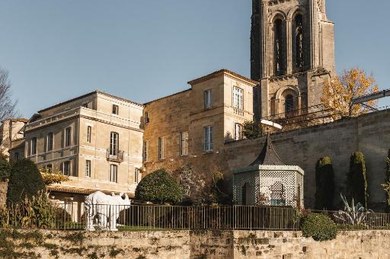
The bell tower above the monolithic church in Saint-Émilion
Photo: Pascal MOULIN, CC BY-SA 4.0

La Table de Pavie is the restaurant in the five-star Hôtel de Pavie, in the middle of the village by the bell tower.

The Michelin Guide has awarded the restaurant two stars, and the chef behind it is Yannick Alléno.

It is the only two-star restaurant in Michelin’s selection for Saint-Émilion and the surrounding area.

The cooking is creative, and the price level is Michelin’s highest, with four euro signs.

The hotel was formerly called Hostellerie de Plaisance, and older guides still use the old name.

Book well ahead, especially for dinner at weekends and in high season.

Two starsHôtel de PavieCreative cookingOn foot
See La Table de Pavie →
One star · Marché-au-Bois

Logis de la Cadène

A narrow street with stone houses in Saint-Émilion
Photo: Nataloche, CC BY-SA 4.0

Logis de la Cadène is on the Place du Marché-au-Bois in the middle of Saint-Émilion and holds one star in the Michelin Guide.

The cooking is modern, and the price level is in Michelin’s top bracket.

The house is also a small four-star hotel, in one of the steepest lanes in the village.

Next door stands the Maison et Porte de la Cadène, the village’s last half-timbered house, with a façade from the early sixteenth century.

It is a good choice for a special dinner in the middle of the village.

Book ahead, especially at weekends and in high season.

One starCentral Saint-ÉmilionModern cookingOn foot
See Logis de la Cadène →
One star · Troplong Mondot

Les Belles Perdrix de Troplong Mondot

The vineyards of Château Pavie, next door to Troplong Mondot
Photo: Megan Mallen, CC BY 2.0

Les Belles Perdrix is the restaurant at the Troplong Mondot wine château, around one and a half kilometres from the village, and holds one star in the Michelin Guide.

Château Troplong Mondot is a Premier Grand Cru Classé in Saint-Émilion.

The cooking is modern, and the price level is in Michelin’s top bracket.

There are also guest rooms at the restaurant.

Older guides often leave out the restaurant, but it is one of four Michelin-starred restaurants in the Grand Saint-Émilionnais.

Book ahead, and plan for a car or taxi out to the château.

One starTroplong MondotIn the vineyardsAbout 1.5 km from the centre
See Les Belles Perdrix →
Michelin-listed · Porte Bouqueyre

L’Huitrier Pie

A town gate and street in Saint-Émilion
Photo: londonexpat, CC BY-SA 2.0

L’Huitrier Pie is on the Rue de la Porte-Bouqueyre at the bottom of Saint-Émilion and is listed in the Michelin Guide.

Listed means the restaurant is in the guide without a star or a Bib Gourmand.

Michelin describes the cooking as modern, and the price level is three euro signs.

There is no Bib Gourmand within 20 kilometres of Saint-Émilion. Le Tertre and L’Envers du Décor in the village are also listed.

The restaurant is a good choice for lunch between the underground tour and a wine château.

Book ahead, especially at weekends.

Listed by MichelinSaint-ÉmilionModern cookingOn foot
See L’Huitrier Pie →
Saint-Jean-de-Blaignac · One star

L’Auberge Saint Jean

The Dordogne at Libourne, further down the river
Photo: JLPC, CC BY-SA 3.0

L’Auberge Saint Jean is on the Rue du Pont in Saint-Jean-de-Blaignac and holds one star in the Michelin Guide.

The cooking is modern, and the price level is three euro signs.

The village lies on the Dordogne, around nine kilometres south of Saint-Émilion as the crow flies.

According to the tourist office, the restaurant regained its star in 2025.

Combine dinner with a day among the bastides and the abbey in Entre-deux-Mers.

Book ahead, especially at weekends and in high season.

One starSaint-Jean-de-BlaignacModern cookingAbout 9 km from Saint-Émilion
See L’Auberge Saint Jean →
Michelin-listed · Château hotel

Château Grand Barrail

The gate of Château Figeac, next door to Grand Barrail
Photo: Ster3oPro, CC BY-SA 4.0

The restaurant at Château Grand Barrail is on the road to Libourne, the D243, and is listed in the Michelin Guide.

Michelin describes the cooking as modern, and the price level is three euro signs.

The château dates from the nineteenth century and stands in the middle of the vineyards, around three kilometres from the village.

Today it is a five-star hotel with a park, a spa and an outdoor pool.

Nearby, La Table de Catusseau in Pomerol is also listed in the Michelin Guide.

Book ahead, and combine dinner with an afternoon among the wine châteaux west of the village.

Listed by MichelinChâteau hotelModern cookingAbout 3 km from Saint-Émilion
See Château Grand Barrail →
Wine · Pomerol and Libourne

Pomerol and Libourne

A boundary stone and vines by Château Pétrus in Pomerol
Photo: Hullie, public domain

Pomerol lies around five kilometres west of Saint-Émilion as the crow flies, on the road to Libourne.

The appellation gained AOC status in 1936, has around 780 hectares of vineyards and no official classification. Merlot clearly dominates.

Among the famous names are Pétrus, Le Pin, Lafleur, Vieux Château Certan and La Conseillante. Pétrus does not receive visitors.

Libourne is a bastide from the late thirteenth century where the Isle meets the Dordogne, founded by Roger de Leybourne for the English king. The centre is the arcaded Place Abel-Surchamp.

La Table de Catusseau in Pomerol is listed in the Michelin Guide, while Michelin has no restaurant in Libourne itself.

Drive or cycle through Pomerol, and finish on the square in Libourne. Libourne station is 7 kilometres from Saint-Émilion.

Around 780 haAOC 1936MerlotHalf day
Read the article →
Bastides · Entre-deux-Mers

The bastides of Entre-deux-Mers

A town gate and arcaded square in a bastide in Entre-deux-Mers
Photo: Henry Salomé, CC BY-SA 3.0

Entre-deux-Mers is the land between the Garonne and the Dordogne south of Saint-Émilion, with bastides founded under English rule in the thirteenth and fourteenth centuries.

Sauveterre-de-Guyenne was founded in 1281 by Edward I of England and still has four town gates and an arcaded square. The market is on Tuesday mornings.

Créon was founded in 1315 and has arcades on three sides of the Place de la Prévôté, where there has been a market on Wednesday mornings since 1315.

Monségur was founded in 1265 by Eleanor of Provence, Queen of England, and has a protected market hall and night markets on Wednesdays in summer.

The Roger Lapébie cycle path runs along a disused railway from Bordeaux to Sauveterre-de-Guyenne, 57.5 kilometres according to Gironde tourism, and passes Créon.

Combine the bastides with the abbey ruins of La Sauve-Majeure, and check the market days before you go.

Since 1265Arcaded squaresCycle pathFull day
Read the article →
Abbey · World Heritage

Abbaye de La Sauve-Majeure

The abbey ruins of La Sauve-Majeure
Photo: Camille Vandoorsselaere, CC BY-SA 4.0

The Abbaye de La Sauve-Majeure is the open-air ruin of a Benedictine abbey, 25 kilometres from Bordeaux and around 19 kilometres south-west of Saint-Émilion as the crow flies.

The abbey lies in the heart of Entre-deux-Mers and is part of the World Heritage Site of the Routes of Santiago de Compostela in France, the pilgrim routes to Santiago.

The Centre des monuments nationaux calls the abbey a masterpiece of Romanesque art.

Tickets cost €7, and the website states free entry for everyone under 26.

The Roger Lapébie cycle path passes close to La Sauve, and it also runs through the bastide of Créon.

Check the opening times on the website before you go, as the abbey is closed on certain days.

Benedictine abbeyWorld Heritage€7, free under 26Half day
Read the article →
Château · On the Garonne

Cadillac-sur-Garonne and Saint-Macaire

The château in Cadillac-sur-Garonne
Photo: Fabien.lotte, CC BY-SA 3.0

Cadillac-sur-Garonne lies on the Garonne, 35 kilometres south-east of Bordeaux and around 31 kilometres south-west of Saint-Émilion as the crow flies. The municipality was simply called Cadillac until 2023.

The Château ducal de Cadillac was built for the Duke of Épernon early in the seventeenth century and was a women’s prison from the nineteenth century until 1952.

The château is run by the Centre des monuments nationaux. Tickets cost €7, and the website states free entry for everyone under 26.

Saint-Macaire further up the Garonne is not a bastide, but a fortified medieval town that grew up around a priory, with town gates from the thirteenth and fourteenth centuries and the arcaded Place du Mercadiou.

Read more about the bastides, the wines and the towns on the Garonne in our guide to Entre-deux-Mers and the bastides, which also covers Saint-Macaire and La Sauve-Majeure.

Check the opening times on the château’s website before you go, and combine the visit with Saint-Macaire on the same day.

Early seventeenth century€7, free under 26On the GaronneFull day
Read the article →