html Pau travel guide | The palace, the boulevard and the Pyrenees | Frankrike.no Skip to content
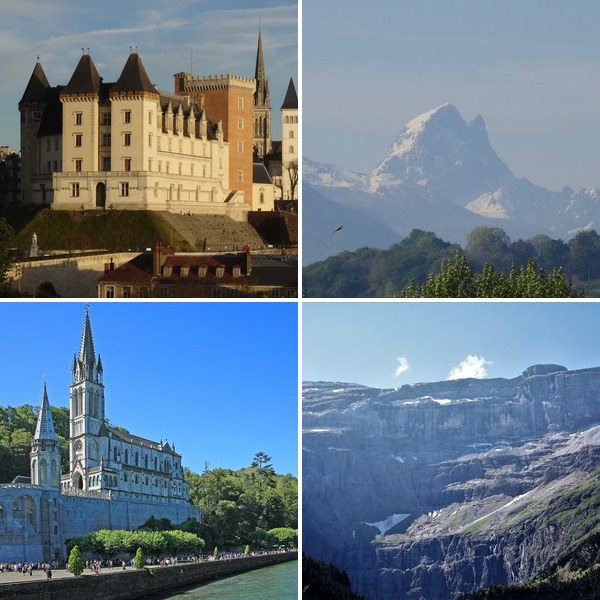
Montage of the Château de Pau, the Pic du Midi d'Ossau seen from Pau, the basilica in Lourdes by the Gave de Pau and the rock walls of the Cirque de GavarniePyrénées-Atlantiques · Royal palace, mountain views and Béarn
France travel guide

Pau

Pau is the capital of Béarn, in Pyrénées-Atlantiques. Henri IV was born in the palace above the Gave de Pau on 13 December 1553, and today the palace is a national museum that you see on a guided tour.

From the 1820s Pau became a resort for wealthy foreign winter visitors. You can see their legacy in the Boulevard des Pyrénées with its view of the mountains, in the Palais Beaumont and in the golf club from 1856, the oldest on the European continent.

The train to Lourdes takes around 27 minutes, and the town is a good base for the Cirque de Gavarnie, the Vallée d'Ossau with the Pic du Midi d'Ossau and the vineyards of Jurançon.

The palace and Henri IVThe Boulevard des PyrénéesLourdes and Gavarnie
Best forRoyal palace, Henri IV, mountain views, the legacy of the winter visitors, the old town, the market hall, Jurançon wine and day trips to the Pyrenees
Ideal forCouples, families, adults, history enthusiasts, walkers, wine enthusiasts and anyone on a tour of the Pyrenees and south-west France
Easy to exploreThe palace, the boulevard and the old town on foot; trains to Lourdes in around 27 minutes; bus line 17 from the airport; two lifts between the Hédas and the upper town
Excellent base forLourdes, the Cirque de Gavarnie, the Vallée d'Ossau and the Pic du Midi d'Ossau, the Jurançon wine route and Lescar
Highlights

Discover Pau

See the palace where Henri IV was born, walk along the Boulevard des Pyrénées with views of the mountains, follow the path through the Hédas and shop at Les Halles. The palace can only be seen on a guided tour of around an hour.

Suggested itineraries

Pau in 1, 3 or 5 days

Choose how long you are staying, and combine the palace and the boulevard with Lourdes, the mountains and the surrounding vineyards.

A classic day in Pau

One day is enough for the palace, the old town, the Hédas and the boulevard, and the market hall if you start early.

MorningStart at Les Halles on the Rue de la République. The stalls are open Tuesday–Saturday from 7am to 1pm and on Sundays from 9am to 1pm, and the hall is closed on Mondays.
Late morningTake the guided tour of the palace, around an hour. Tours run from 9.30am to 11.45am and from 2pm to 5pm, and tickets cost €10.
AfternoonWalk around the old town, see the Parlement de Navarre from the outside and follow the path through the Hédas, then walk the Boulevard des Pyrénées to the Parc Beaumont.
EveningHave dinner at Omnivore by the palace, which has a Bib Gourmand, or at L'Interprète in the centre. Both are closed on Sundays and Mondays.
Choose the right area

Where should you stay in Pau?

The choice is between the old town by the palace, the centre by the boulevard, the parks in the east of the town, Lescar on the airport road or Lourdes by the sanctuary. It decides the walking distance, the atmosphere and the price.

By the palace

Place Gramont

The 4-star Hôtel de Gramont is on the Place Gramont in the old town, a couple of hundred metres from the palace and right by Omnivore.

The shortest walk to the palace and the old town, and everything in the centre can be reached on foot.
In the heart of the centre

Rue Gambetta and Rue Émile Garet

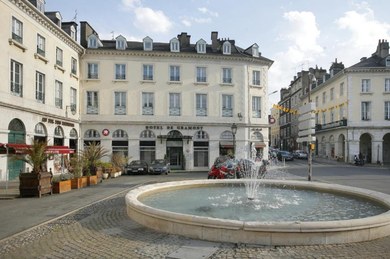
The 3-star Hôtel Bristol is on the Rue Gambetta, a block from the Boulevard des Pyrénées, and the 4-star Hôtel du Palois is on the Rue Émile Garet near Les Halles.

Suits anyone who wants to walk to the palace, the boulevard and the market hall.
Five stars

Parc Beaumont and Trespoey

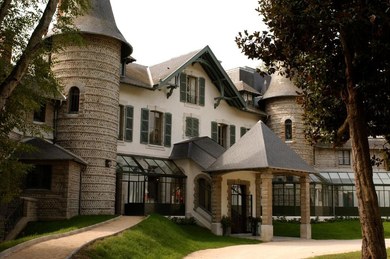
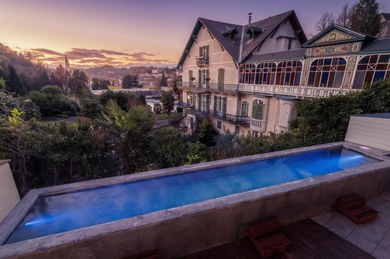
The 5-star Hôtel Parc Beaumont with a spa is in the Parc Beaumont at the eastern end of the boulevard, and the 5-star Villa Navarre is a Belle Époque villa in a park in the residential district of Trespoey.

Quiet and green, in the parks east of the centre.
By car

Lescar

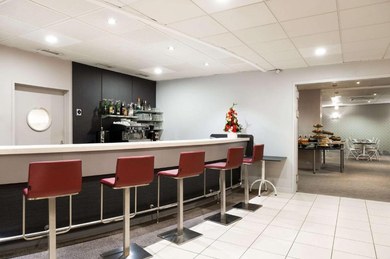
The 4-star Novotel Pau Pyrénées is in Lescar, around 5.5 kilometres west of the centre, between the airport and Pau.

You need a car, but it suits families and anyone landing at Pau-Pyrénées.
The pilgrimage town

Lourdes

Lourdes is around 34 kilometres east-south-east of Pau. The Grand Hôtel Belfry has 5 stars and a spa, and the 4-star Hôtel Padoue is a few minutes’ walk from the sanctuary.

Suits anyone who wants to see the candlelight procession in the evening without taking the train back to Pau.
Selected places to stay

Places to stay in and around Pau

Here are some of our selected places to stay in and around Pau, from 3 to 5 stars, in the centre, by the Parc Beaumont, in Lescar and in Lourdes. Compare walking distance to the palace and the station.

Hôtel Parc Beaumont – MGallery Collection in Pau★★★★★
City centre

Hôtel Parc Beaumont – MGallery Collection

A five-star hotel with a spa in Parc Beaumont, at the east end of the Boulevard des Pyrénées.

Hôtel Villa Navarre in Pau★★★★★
East of the centre

Hôtel Villa Navarre

A five-star hotel in a Belle Époque villa with a park, east of the centre.

Grand Hôtel Belfry in Lourdes★★★★★
Lourdes

Grand Hôtel Belfry

A five-star hotel with a spa in Lourdes, within walking distance of the Sanctuary.

The map shows our selected hotels in Pau and the surrounding area and in Lourdes. Click a marker for a photo and more information.
Camping and motorhomes

Camping near Pau

There is no classified campsite in Pau itself. The nearest is the 3-star City Nature, formerly Le Terrier, in Lescar by the Gave de Pau, and there are more sites in the Vallée d'Ossau and around Lourdes.

Mountains, wine and cycle routes

The landscape around Pau

The mountains by bike

The Tour de France in Pau

A stage of the 2027 Tour de France starts in Pau on 22 July, heading for the Col du Portet. For more routes, see our guide to cycling in France.

The mountain you see from the town

Pic du Midi d'Ossau

The Pic du Midi d'Ossau, 2,884 metres, is the pointed ‘tooth’ of the Vallée d'Ossau, the remains of an old volcano in the Parc national des Pyrénées. Unlike the Pic du Midi de Bigorre, it has no cable car.

The Pyrenees

Béarn and the mountain range

Pau is the capital of Béarn, at the foot of the mountain range. Read more in our guide to the Pyrenees, where Lourdes and Gavarnie are also included.

Car hire from Pau Airport

A car for your day trips

Pau Airport (PUF) is about 10 km north of Pau as the crow flies. With your own car you can more easily reach the Cirque de Gavarnie, the Vallée d'Ossau and the Jurançon wine route.

Pilgrimage town, mountains and wine

Four good day trips from Pau

Pau lies on the Gave de Pau with the Pyrenees to the south. To the east is Lourdes in the neighbouring department of Hautes-Pyrénées, the Cirque de Gavarnie is at the head of the valley further south-east, the Vallée d'Ossau is due south, and the Jurançon vineyards begin on the other side of the river.

Continue your journey

More destinations from Pau

Pau fits into a tour of south-west France, with Biarritz on the coast to the west, Toulouse to the east and Arcachon further north.

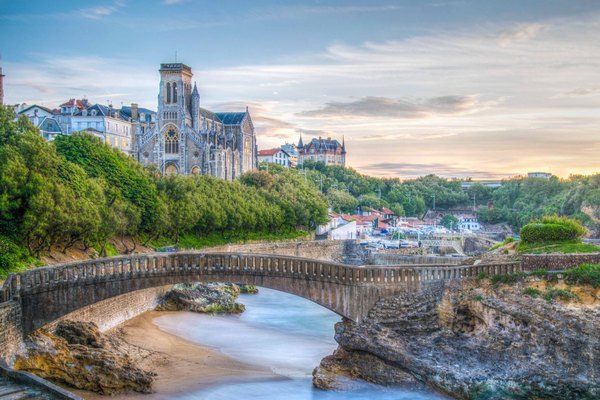
The Église Sainte-Eugénie above the Port des Pêcheurs in Biarritz, with the stone bridge by the Rocher du Basta
On the Basque coast

Biarritz

Combine Pau with the beaches and the harbour of Biarritz, around 100 kilometres west of Pau as the crow flies.

Open the Biarritz guide →
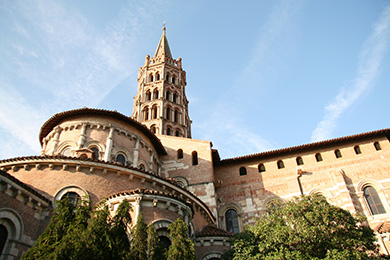
The Basilique Saint-Sernin in Toulouse with its octagonal red-brick bell tower
The city on the Garonne

Toulouse

Travel on east to Toulouse and the Basilique Saint-Sernin, around 150 kilometres away as the crow flies.

Open the Toulouse guide →
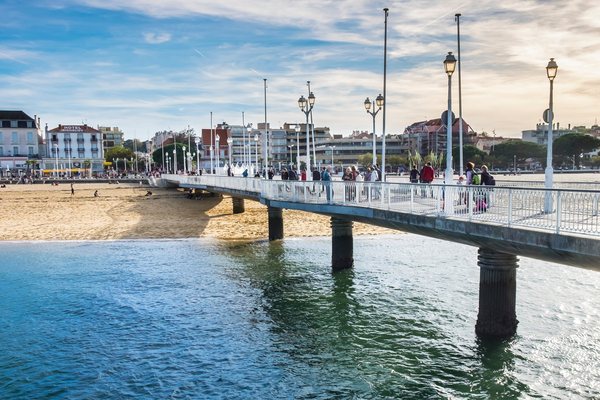
The Jetée Thiers in Arcachon seen from the water, with the seafront promenade and the houses behind
On the Atlantic

Arcachon

Continue north to Arcachon and the Bassin d'Arcachon, around 165 kilometres from Pau as the crow flies.

Open the Arcachon guide →
Read more

Read our inspiring articles about France

Find inspiration in travel guides, touring itineraries and personal tips from across France. Discover cities, villages, food and wine experiences, nature and new destinations.

Royal palace · National museum

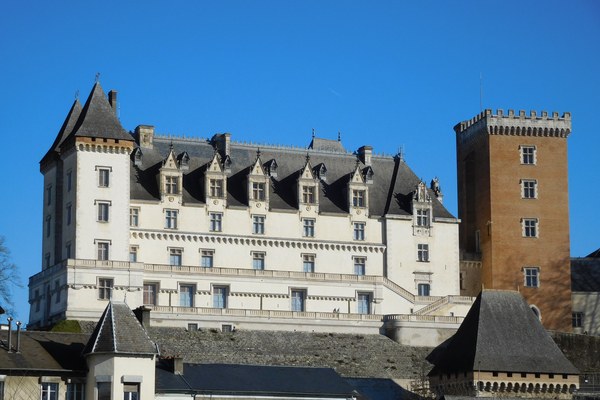
Château de Pau

The Château de Pau with the white Renaissance wing and the brick tower seen from below
Photo: Superchilum, CC BY-SA 4.0

The palace stands on a rocky spur above the Gave de Pau and the Hédas stream. Gaston Fébus rebuilt it as a brick fortress in the fourteenth century, and from 1512 it was the palace of the kings of Navarre.

Henri IV was born here on 13 December 1553. The tortoise shell that is his legendary cradle is in the Chambre du roi, but that room was furnished in the nineteenth century, and the birth probably took place on the floor below.

The palace can only be seen on a guided tour, which takes around an hour. Tours start from 9.30am and 2pm, with last admission at 11.45am and 5pm. The palace is open every day except 1 January, 1 May and 25 December.

Tickets cost €10, reduced €8. Under-18s go free, as do 18–25-year-olds from the EU or who have lived in the EU for more than three months. On the first Sunday of the month it is free for everyone, all year.

Individual visitors do not need to book, and you buy your ticket on site. Children under 12 must be accompanied by an adult. The park, the gardens and the Basse-Plante are free all year from 8am.

The Salle aux Cent Couverts has tapestries and a marble statue of Henri IV from 1605. The palace has no car park of its own and recommends the Place de Verdun, with 1,470 spaces.

Henri IV born 1553€10, free under 18Guided tours onlyApprox. 1 hour
See tours and tickets →
Promenade · View of the Pyrenees

Boulevard des Pyrénées

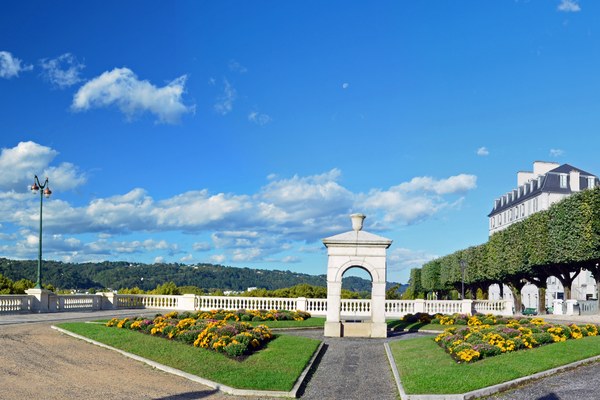
The stone pavilion above the fountain at the Place Royale on the Boulevard des Pyrénées, with flower beds and the hills south of the town
Image from Frankrike.no.

The Boulevard des Pyrénées is a promenade of almost 2 kilometres from the palace gates to the Parc Beaumont and the Palais Beaumont, with a 180-degree panorama of the Pyrenees.

The article on Lourdes tells you about the sanctuary and the candlelight procession in the pilgrimage town east of Pau.

The engineer Alphand designed the promenade in 1891, half on the edge of the plateau and half on a viaduct with 49 pillars. In 1900 the two parts were joined south of the Place Royale.

Lamartine wrote that Pau has the most beautiful land view in the world, just as Naples has the most beautiful sea view. The views have been protected since 1944.

The tourist office is on the Place Royale, which the boulevard passes. You see the mountains when the weather is clear.

The funicular from the station goes up to the boulevard, but it has been out of service since 30 March 2026, so check before you go.

Almost 2 km180° panoramaPlace RoyaleOn foot
See the boulevard at the tourist office →
District · Pedestrian streets and the Hédas

The old town and the Hédas

The spire of the church of Saint-Martin above the roofs of the old town in Pau
Image from Frankrike.no.

The palace quarter is pedestrianised, with the old streets around the palace and the Parlement de Navarre.

The Hédas is one of the oldest quarters of Pau, named after the stream that ran in the ravine between the palace hill and the rest of the town. For a long time it was a working-class quarter where the stream powered the crafts.

A 1.5-kilometre path runs through the Hédas from the Place d'Espagne to the palace, and it is accessible for wheelchairs and pushchairs.

Two lifts, on the Rue des Cordeliers and on the Place d'Espagne, and several flights of steps connect the lower and the upper town.

The restaurant Paute is in a stepped alley in the Hédas and is recommended in the Michelin Guide.

Les Halles on the Rue de la République is open Tuesday–Saturday from 7am to 1pm and on Sundays from 9am to 1pm, and on the last Friday of the month there is an evening market from 7pm to 11pm.

Pedestrian streets1.5 km pathTwo liftsOn foot
See the Hédas at the tourist office →
Funicular · Free when running

Funiculaire de Pau

The green funicular car at the lower station, with the track up towards the Boulevard des Pyrénées
Photo: MOSSOT, CC BY-SA 4.0

The funicular connects the railway station with the Boulevard des Pyrénées. It is over a hundred years old and is free when it runs.

The tourist office gives over 450,000 passengers a year and a departure every three minutes in normal service.

The funicular has been out of service since 30 March 2026, and we have not found a firm date for when it will reopen.

Check the status with the tourist office before you go.

The lower station is by the railway station, and the upper station is on the boulevard near the Place Royale.

Next to the track a footpath and a flight of steps lead up to the boulevard.

FreeClosed from 30 March 2026Station to boulevardCheck before you go
See the funicular at the tourist office →
Park · Belle Époque

Parc Beaumont and the Palais Beaumont

The Palais Beaumont with its yellow façade and two white bell towers
Photo: Anne Dieu-Le-Veut, CC BY-SA 4.0

The Parc Beaumont is an English-style park at the eastern end of the Boulevard des Pyrénées, where the promenade ends.

The Palais d'Hiver was inaugurated on 4 November 1898 on the edge of the park. The architect was Émile Bertrand, and the building had a 1,800-square-metre palm house.

The building has been a casino and a hospital, and since 2000 the Palais Beaumont has been a conference centre for up to 750 people.

Anna de Noailles gave the land to the town, and the kiosk in the park bears her name.

The 5-star Hôtel Parc Beaumont with a spa is in the park.

The Musée des Beaux-Arts is close by, but is closed until 17 December 2026. Admission is free when the museum is open.

Palais from 1898English-style parkConference centreOn foot
See the Palais Beaumont at the tourist office →
Historic building · By the palace

Parlement de Navarre

The Parlement de Navarre with its white façade, the bell tower with a pointed roof and the terrace wall in front
Photo: Flo641, CC BY-SA 4.0

In 1620 Béarn was incorporated into the French crown, and the États de Béarn assembly became the Parlement de Navarre, with its seat in Pau.

The parliament met in the law courts that were built in 1585 on the orders of Henri IV. The main building burned down in 1716 and was rebuilt from 1722.

After the parliament was dissolved in 1789, the building was a court until 1856 and later a school, a museum and an archive, among other things.

The tower next to it is the bell tower of the old church of Saint-Martin, which was demolished in 1884.

Today the departmental council of Pyrénées-Atlantiques holds its meetings here.

The building can usually only be seen from the outside. During the Journées européennes du patrimoine in September there have been guided tours.

From 1620Place de la DéportationSeen from outsideBy the palace
See the palace quarter at the tourist office →
Pau · Bib Gourmand

Jumo & Co

The Rue Henri-IV in Pau in the evening light, with bunting above the street and the tower by the palace at the end
Photo: Poudou99, CC BY 4.0

Jumo & Co is on the Rue Henri-IV in the centre of Pau and holds a Bib Gourmand in the Michelin Guide.

The Bib Gourmand is Michelin’s mark for restaurants with particularly good value for money.

Twin brothers run the place, one as chef and the other as pastry chef, with a patisserie counter and a tearoom on two floors.

Michelin describes the cooking as inventive, generous and light. The price level is one euro sign.

Jumo & Co is open Monday–Thursday from 8.30am to 6.30pm, on Fridays and Saturdays from 8.30am to 9.15pm and on Sundays from 8.30am to 1pm.

Dinner is only served on Fridays and Saturdays, so come for lunch on the other days.

Bib GourmandRue Henri-IVBistro and patisserieDinner Fri–Sat
See Jumo & Co →
Pau · Bib Gourmand

Omnivore

The Place Gramont in Pau seen from above, with the rows of houses, the trees and the spires of Saint-Jacques behind
Photo: Will6475, CC BY-SA 4.0

Omnivore is on the Place Gramont, a stone’s throw from the palace, and holds a Bib Gourmand in the Michelin Guide.

It is a warm bistro with a zinc bar and upholstered banquettes.

The blackboard menu has fresh fish from the market and slow-cooked pork, generous traditional dishes with touches of citrus or smoke. The price level is two euro signs.

Omnivore is open Tuesday–Friday from 12pm to 1.30pm and 7.30pm to 9.30pm and on Saturday evenings, and closed on Sundays and Mondays.

The Hôtel de Gramont is on the same square.

Book ahead, especially for dinner at weekends.

Bib GourmandPlace GramontBistroClosed Sun–Mon
See Omnivore →
Pau · Recommended

L'Interprète

The Place de la Libération in Pau with the Église Saint-Jacques and the colonnade of the Palais de Justice
Photo: Theo.ortolan, CC BY-SA 4.0

L'Interprète is on the Rue des Orphelines in the centre of Pau and is recommended in the Michelin Guide, with the Coup de cœur label.

The head chef Quentin Maysou makes creative seasonal cooking on set menus chosen by the chef.

The bistro is decorated in a ‘bohème chic’ style, and the price level is three euro signs.

The restaurant is open Tuesday–Saturday from 12pm to 2pm and 7.30pm to 9.30pm, and closed on Sundays and Mondays.

It is around 300 metres east of the Place Royale.

Book ahead, especially at weekends.

RecommendedRue des OrphelinesCreative cookingClosed Sun–Mon
See L'Interprète →
Hédas · Recommended

Paute

The tall old houses on the edge of the Hédas ravine in Pau, with the spire of Saint-Martin
Photo: Will6475, CC BY-SA 4.0

Paute is in the Passage Darracq on the Rue du Hédas and is recommended in the Michelin Guide.

Two friends from catering school run the restaurant in a stepped alley in one of the oldest quarters of Pau.

The cooking is creative, with herbs, spices, vinegars, citrus and butter-mounted sauces. The price level is two euro signs.

Paute is open on Mondays, Tuesdays, Thursdays and Fridays from 12pm to 1.30pm and 7.30pm to 9pm and on Wednesdays for dinner only, and closed on Saturdays and Sundays.

It is often full, so book a table.

Combine dinner with a walk along the path through the Hédas.

RecommendedHédasCreative cookingClosed Sat–Sun
See Paute →
Jurançon · Recommended

Flaveurs – Domaine Mont-Riant

The vineyard by the Chapelle de Rousse in Jurançon in winter, with the Pic du Midi d'Ossau in the background
Photo: ddfreedl, CC BY-SA 2.0

Flaveurs is at the Domaine Mont-Riant on the Avenue des Frères-Barthélémy in Jurançon and is recommended in the Michelin Guide.

The restaurant is in a white nineteenth-century villa with a slate roof, in a wooded park with views over the landscape and Pau.

The head chef Patxi Massonde makes modern dishes from produce from Béarn and Jurançon. The price level is three euro signs.

The restaurant serves dinner only on Tuesdays and Wednesdays and lunch and dinner Thursday–Saturday, and is closed on Sundays and Mondays.

The restaurant is around 3.5 kilometres west of the centre of Pau as the crow flies.

Combine dinner with a day on the Jurançon wine route.

RecommendedJurançonModern cookingApprox. 3.5 km
See Flaveurs →
Lescar · Recommended

Arraditz

The cathedral of Notre-Dame in Lescar with the Romanesque choir and the octagonal bell tower
Photo: Flo641, CC BY-SA 3.0

Arraditz is on the Rue Cachau in Lescar and is recommended in the Michelin Guide.

The restaurant is in a nineteenth-century house, run by a chef from Lescar with the chef’s partner in the dining room.

The cooking is modern and local, with balanced dishes from land and sea and generous portions. The price level is two euro signs.

Lescar is around 7 kilometres north-west of Pau as the crow flies.

The restaurant is open Wednesday–Saturday from 12pm to 1.30pm and 8pm to 9.30pm and for lunch on Sundays, and closed on Mondays and Tuesdays.

Book ahead, especially at weekends.

RecommendedLescarModern cookingApprox. 7 km
See Arraditz →
Pilgrimage site · Hautes-Pyrénées

Lourdes

The Basilique de l'Immaculée-Conception and the Rosary Basilica by the Gave de Pau in Lourdes, with the Château fort behind
Photo: Guérin Nicolas, CC BY-SA 3.0

Lourdes is around 34 kilometres east-south-east of Pau as the crow flies, in the department of Hautes-Pyrénées in Occitanie, not in Pyrénées-Atlantiques.

Bernadette Soubirous was 14 when she saw 18 apparitions in the Grotte de Massabielle from 11 February to 16 July 1858.

The sanctuary covers 55 hectares with three basilicas, among them the underground Saint-Pie-X, which holds 20,000 people. Around 4 million visitors came in 2025.

The candlelight procession is held every evening at 9pm from April to November, and the rest of the year there is a candlelight prayer every evening at 8.30pm.

The train from Pau takes around 27 minutes, and there are 17 trains a day.

Around 15 August it is very crowded, so choose another day if you can.

Approx. 27 min by trainCandlelight procession 9pmApprox. 4 million in 2025Full day
Read the article →
Mountains · World Heritage

Cirque de Gavarnie

The Grande Cascade falling down the grey rock wall in the Cirque de Gavarnie
Photo: Carlespina, CC BY 4.0

The Cirque de Gavarnie is in Hautes-Pyrénées, around 69 kilometres from Pau as the crow flies, and is part of the Pyrénées – Mont Perdu World Heritage Site.

The cirque is 6.5 kilometres in circumference, with walls of 1,500 metres and peaks over 3,000 metres.

The Grande Cascade is around 420 metres high and the highest waterfall in France.

The wide path from the village to the Hôtellerie du Cirque takes around an hour each way, with a gentle climb. From Easter to All Saints’ Day you can also ride a donkey or a horse.

Dogs are forbidden in the core zone of the national park, even on a lead, and drones are forbidden below 1,000 metres above the ground.

Without a car, take the train to Lourdes and the liO 965 bus onwards. There is a charge for parking in Gavarnie.

Waterfall approx. 420 mWorld Heritage 1997Approx. 1 hr each wayFull day
Read the article →
Mountain valley · Béarn

Vallée d'Ossau

The Pic du Midi d'Ossau with its double summit above wooded slopes in autumn colours
Image from Frankrike.no.

The Vallée d'Ossau is one of the three mountain valleys of Béarn. The Pic du Midi d'Ossau, 2,884 metres, is the pointed ‘tooth’ of the valley, the remains of an old volcano in the Parc national des Pyrénées.

Read more about the great rock walls further east in our article on the Cirque de Gavarnie, which also covers Troumouse and Estaubé.

Do not confuse the peak with the Pic du Midi de Bigorre, which has the observatory and the cable car from La Mongie in Hautes-Pyrénées. The Pic du Midi d'Ossau has no cable car.

From the Lac de Bious-Artigues an easy walk runs along the lake, and the trails towards the summit start there. The circuit around the Pic du Midi d'Ossau takes around eight hours, and climbing requires experience and a helmet.

Le Petit Train d'Artouste runs at an altitude of around 2,000 metres over 10 kilometres. With the gondola from Fabrèges the trip costs €28 for adults and €20 for children aged 4 to 12.

In 2027 the train runs from 8 May to 3 October. Allow around three and a half hours for the whole trip.

Summit 2,884 mArtouste train €28May–OctoberFull day
See the Vallée d'Ossau →
Wine · Close to Pau

Jurançon wine

Vineyards in Jurançon with the snow-covered Pyrenees on the horizon
Photo: Capbourrut, CC BY-SA 4.0

Jurançon is a white wine, both sweet (moelleux) and dry (sec). The AOC Jurançon for the sweet wine came in 1936, and Jurançon sec in 1975.

The main grapes are Gros Manseng and Petit Manseng. The grapes dry on the vine in the sun and the warm foehn wind from the Pyrenees.

According to legend, the newborn Henri IV was given a few drops of Jurançon by his grandfather. The whole appellation covers around 1,200 hectares.

The wine route runs from Jurançon via Lacommande to Monein and requires a car. The Maison du Jurançon in Lacommande offers free tastings of around 130 wines.

If you would rather head for the mountains, read our article on the Cirque de Gavarnie, another day trip from Pau.

Flaveurs at the Domaine Mont-Riant in Jurançon is recommended in the Michelin Guide, around 3.5 kilometres from the centre of Pau.

White wineAOC 1936Approx. 1,200 hectaresHalf day
See Jurançon wine →