
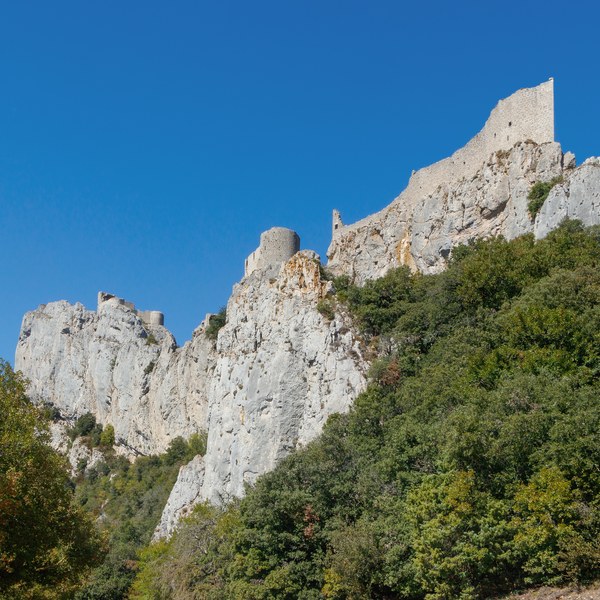
The most important thing first: you need a car, because we have not found public transport to the castles in the Corbières. In winter Termes and Puilaurens are closed, while Peyrepertuse, Quéribus and Carcassonne are open almost every day. The prices and times in this guide are from the sources in November 2026.
Before you go – car, wind and winter
- Car: the castles stand on mountain ridges in the Corbières, and we have not found bus connections there. Carcassonne can be reached by train from Narbonne.
- Wind and thunder: the castles may close or advise against visits in strong wind and thunderstorms. Check the website the day before.
- Winter 2026/27: Peyrepertuse, Quéribus and Carcassonne are open, Lastours is closed in January outside the school holidays, and Termes and Puilaurens are closed for the season.
- Walking: Quéribus is reached in approx. 10 minutes from the car park and Peyrepertuse in approx. 20 minutes from the ticket office. The loop to the castles in Lastours takes approx. 2 hours and 30 minutes.
The World Heritage Site from 2026 – eight fortresses
The UNESCO World Heritage Committee inscribed the fortresses on the list at its 48th session in Busan in South Korea on 26 July 2026. The name is “Forteresses royales capétiennes du Languedoc”, the Royal Capetian Fortresses of Languedoc. The nomination was called “The System of Fortresses of the Seneschalty of Carcassonne (13th–14th centuries)”, and the name was changed in the same decision.
- The eight components: Château et remparts de Carcassonne, Aguilar (Tuchan), Lastours, Montségur (Ariège), Peyrepertuse (Duilhac and Rouffiac), Puilaurens, Quéribus (Cucugnan) and Termes.
- Not included: Villerouge-Termenès and Arques, even though both lie in the same area.
- The town of Carcassonne: the fortified town has been a World Heritage Site since 1997, as a separate listing.
- The justification: a defensive system of originally 22 fortresses, built to protect the seat of the seneschalty of Carcassonne, secure the new royal lands, watch the border with the Kingdom of Aragon and control the roads. UNESCO calls it the only coherent system of fortresses built by the Capetian kings.
- Size: 78.35 hectares, with a buffer zone of 9,405 hectares.
The name on the tentative list from 2017, “Cité de Carcassonne et ses châteaux sentinelles de montagne”, is not the name of the World Heritage Site. See UNESCO’s page on the fortresses and forteressesroyalesdulanguedoc.fr, which is run under the Département de l'Aude.
The Cathars, the crusade and the border with Aragon
- 1208: the papal legate Pierre de Castelnau, a monk at Fontfroide, was killed. Pope Innocent III called a crusade against the Cathars – the Albigensian Crusade.
- August 1209: Carcassonne was besieged and surrendered after 15 days.
- 1210: Termes held out for almost four months. The defenders gave up when the water ran out.
- 1226 and 1229: the king annexed the viscounty in 1226, and the Treaty of Meaux-Paris ended the crusade in 1229.
- 1240: Raymond II Trencavel rebelled and besieged Carcassonne, without success.
- 16 March 1244: Montségur surrendered after a siege from the spring of 1243.
- May 1255: Quéribus was surrendered to the king.
- 1258: the Treaty of Corbeil fixed the border between France and Aragon. The castles became border fortresses with royal garrisons.
- 1659: the Treaty of the Pyrenees gave Roussillon to France. The border moved south, and the fortresses lost their importance.
After 1229 and 1240, Quéribus and Puilaurens became refuges for Cathars and faidits, lords who had lost their lands. In Puilaurens a community of Cathar “parfaits” lived in 1242–1243. The history is told by Forteresses royales du Languedoc.
“Cathar castles” – a disputed name
The castles are often called the “Cathar castles”, but UNESCO calls them royal fortresses built after the crusade, and Aude Tourisme has switched to “Forteresses royales du Languedoc”. Some of the castles were refuges for Cathars for a short period. The ruins standing today are mainly royal structures from after 1240.
- Peyrepertuse: the peak of construction was in 1250–1251. The fortress was never besieged.
- Puilaurens: rebuilt from August 1255.
- Termes and Aguilar: the outer curtain wall dates from the last third of the 13th century.
- Lastours: the old castle village was demolished in 1240, and the new castles were finished before 1260.
- Montségur: the castle standing today was built after 1245.
Peyrepertuse
Peyrepertuse lies on a mountain ridge above the village of Duilhac-sous-Peyrepertuse, almost 800 metres above sea level. The ridge runs from 600 to 850 metres. In 1302 the fortress had a garrison of 21 sergeants.
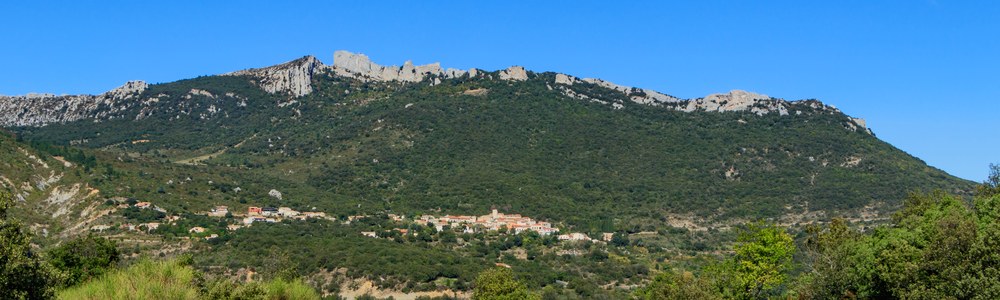
- Walking: approx. 20 minutes from the ticket office, 15–20 minutes from the car park and approx. 45 minutes from the village. Coaches and motorhomes over 7 metres park halfway, and from there it is 1.5 kilometres on foot.
- Open: every day all year round except 24, 25 and 31 December and 1 January. November–January 10am–4.30pm, February 10am–5pm and March 10am–6pm.
- Price 2026: 9 euros, reduced 8 euros, ages 6–12 4.50 euros and free under 6. The ticket is for a set time slot. Audio guide 4 euros.
- From Narbonne: approx. 71 kilometres and 1 hour and 25 minutes by car.
See peyrepertuse.com.
Quéribus
Quéribus stands on top of a steep limestone ridge above Cucugnan, 728 metres above sea level. In May 1255 Chabert de Barbaira surrendered the castle to the king in exchange for freedom, after a siege of less than a month. The siege was more about the border with Aragon than about the Cathars. Afterwards the king kept a castellan and 20 men in the castle.
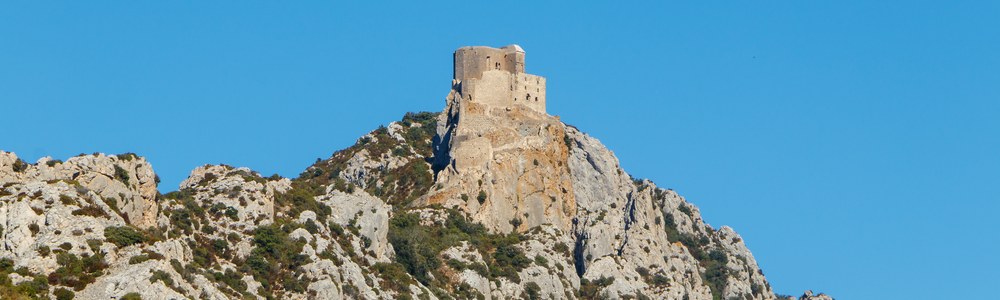
- Walking: approx. 10 minutes on an easy path. Parking is free.
- Open: all year round except 25 December and 1 January. November–March 10am–4.30pm.
- Price 2026: 9 euros, reduced 8 euros, ages 6–12 5.50 euros. Family ticket DUO 24 euros and MONO 17 euros. Audio guide 4 euros for two.
- Wind: access is advised against in strong wind and forbidden during thunderstorms.
- From Narbonne: approx. 67 kilometres and 1 hour and 15 minutes by car.
Times and prices are published by the municipality of Cucugnan, which runs the castle.
Termes
Termes lies on a spur above wooded valleys, 460 metres above sea level. In 1210 Raymond de Termes held out for almost four months against the crusaders. The castle was blown up on royal orders in 1652–1653, and today the ruins remain.
- Walking: 400 metres, approx. 15 minutes from the reception.
- Winter: closed for the season from 11 November 2026. In March it is open at weekends 10am–5pm.
- Price 2026: 6 euros, ages 16–25 5 euros and ages 6–15 3 euros. A joint pass for Termes, Lagrasse and Villerouge costs 17 euros.
- Wind: the castle may close without notice in very strong wind, storms or flooded roads.
- From Narbonne: approx. 64 kilometres and 1 hour and 10 minutes by car.
See chateau-termes.com.
Aguilar
Aguilar lies on a hill above Tuchan, 296 metres above sea level. The outer curtain wall with round towers dates from the last third of the 13th century.
- Winter: Aude Tourisme gives a period from 11 November to 31 December 2026, but not which days. Phone before you go.
- Price: from 4 euros, children 2 euros.
- From Narbonne: approx. 51 kilometres and 1 hour by car.
See Aude Tourisme.
Puilaurens
Puilaurens stands on a limestone cliff 697 metres above sea level. The castle was a refuge for Cathars in the 1240s and was rebuilt from August 1255. In 1258 it had a garrison of 25 men.
- Walking: approx. 15 minutes, only from the south.
- Winter: closed. The 2026 season was 21 March–11 November.
- Price 2026: 7 euros, ages 6–15 4 euros and reduced 6 euros.
- Thunder: the castle may close during thunderstorms.
- From Narbonne: approx. 112 kilometres and 1 hour and 45 minutes by car.
Lastours – four castles on one ridge
In Lastours four castles stand one after the other on a mountain ridge, 260–285 metres above sea level: Cabaret, Tour Régine, Surdespine and Quertinheux. The old castle village was demolished in 1240, and the new castles were finished before 1260.
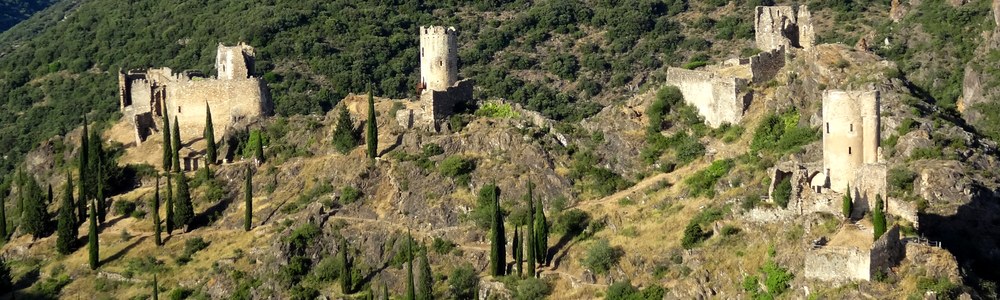
- The trail: the loop to the castles takes approx. 2 hours and 30 minutes. The viewpoint can be reached without effort, but is closed for the winter from 16 November.
- Open: 9.30am–4.30pm in October–December and February–March. Closed on 25 December and in January outside the school holidays.
- Price: from 9 euros.
- Heat: the castles have been closed because of heat in summer.
- From Narbonne: approx. 75 kilometres and 1 hour and 5 minutes by car.
Montségur in the Ariège
Montségur lies in the Ariège, outside the Aude, 1,207 metres above sea level. The castle was besieged from the spring of 1243 and surrendered on 16 March 1244. According to the chronicles, 225 people were burned, and 68 of them are known by name.
The castle standing today was built after 1245, at the end of the 13th century or early in the 14th century. Montségur is one of the eight components of the World Heritage Site. See Forteresses royales du Languedoc for the visit.
Villerouge-Termenès and Arques – outside the World Heritage Site
Villerouge-Termenès is associated with Guilhem Bélibaste, called “the last Cathar parfait”. In the second wing of the castle, the Rôtisserie médiévale serves food from the 14th century.
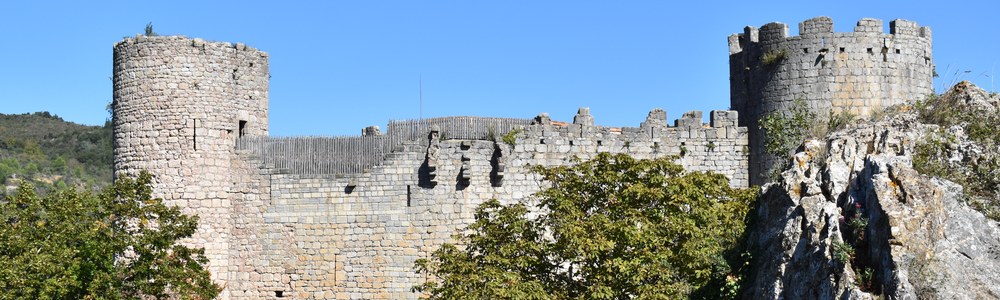
- Villerouge – open: Saturday and Sunday 10am–5pm until 10 December 2026. The times after that have not been published.
- Villerouge – price: 7 euros, children 3 euros. Approx. 45 kilometres and 50 minutes by car from Narbonne.
- Arques: the keep is 24 metres high, with four towers. The ticket also covers the Maison Déodat Roché, which is open from mid-June to mid-September 1.30–5pm.
- Arques – price: from 5 euros, children 2–3 euros. The winter times have not been published. Approx. 75 kilometres and 1 hour and 25 minutes from Narbonne.
Cucugnan and Duilhac
Below the castles lie two small villages: Cucugnan below Quéribus, with around 120 inhabitants, and Duilhac-sous-Peyrepertuse below Peyrepertuse, with 140. Between the two castles it is 25 minutes by car.
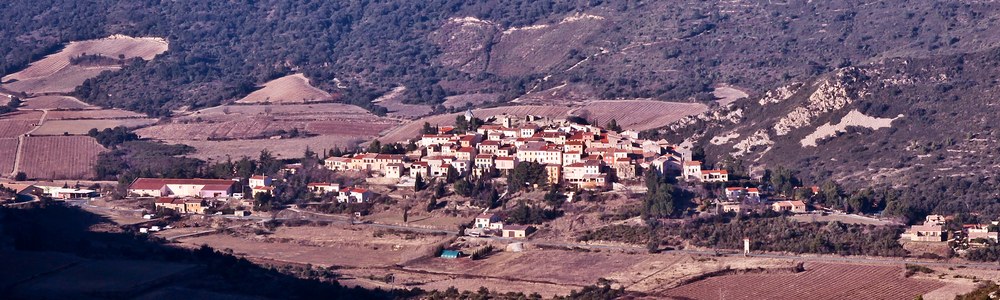
- Espace audiovisuel Achille Mir in Cucugnan: 4.50 and 5.50 euros.
- The tourist office for the Corbières: Office de tourisme intercommunal des Corbières, 2 route de Duilhac in Cucugnan, telephone 04 68 45 69 40.
Gorges de Galamus
The Gorges de Galamus is a gorge with steep limestone walls between Cubières-sur-Cinoble and Saint-Paul-de-Fenouillet. The road is narrow and has alternating one-way traffic. In the mountainside lies the hermitage of Saint-Antoine.
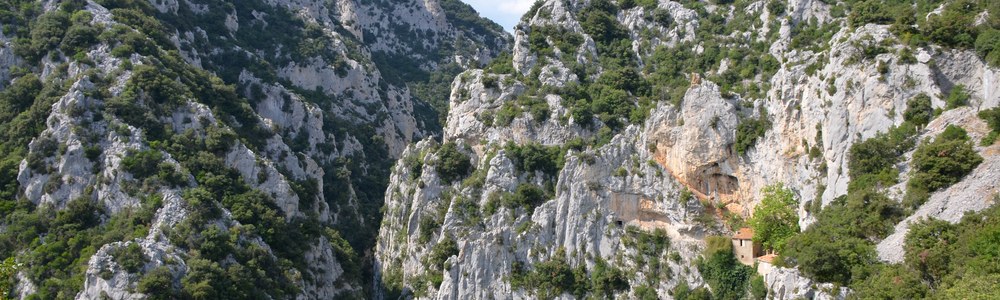
- Summer bus: 6 July–31 August 2026 11am–6pm, and liO line 506 from the surrounding villages.
- Canyoning: is regulated by a decision of the prefecture.
- From Narbonne: approx. 97 kilometres and 1 hour and 25 minutes by car.
See gorgesdegalamus.fr.
Carcassonne – the castle and the ramparts
The fortified town of Carcassonne has been a World Heritage Site since 1997, and the Château et remparts de Carcassonne is one of the eight components of the fortresses from 2026. It was from here that the seneschal governed, and the fortresses in the mountains were to protect the town and the border.
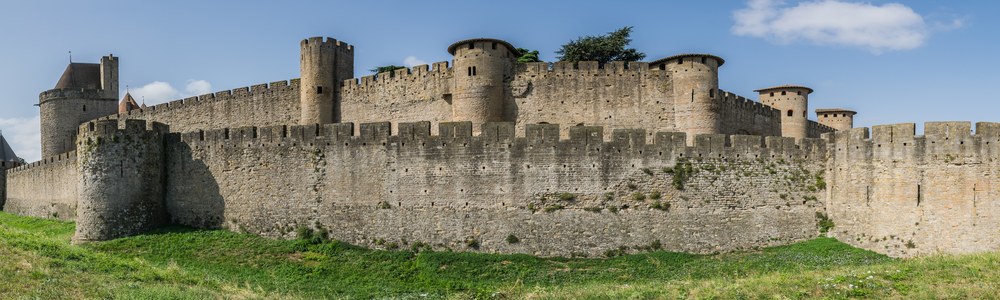
- The walls: almost 3 kilometres in two rings, with 52 towers, 1,300 arrow slits and four gates with barbicans. The outer ring is 1,672 metres. The inner one is built on Roman walls from the end of the 3rd century and the 4th century.
- The restoration: the site was listed as a historic monument in 1849 and restored in 1853–1910. Viollet-le-Duc led the work until the architect’s death in 1879.
- Château comtal and the ramparts: 1 October–31 March 9.30am–5pm and 1 April–30 September 10am–6.30pm. Last entry 45 minutes before closing. Closed on 1 January, 1 May and 25 December. The visit takes approx. 2 hours.
- Price: 13 euros in October–March and 19 euros in April–September. Free under 18 and for 18–25-year-olds from the EU/EEA, and free on the first Sunday of the month from January to March.
- From Narbonne: approx. 60 kilometres and 45 minutes by car, or by train on the Narbonne–Toulouse line.
The castle and the ramparts are run by the Centre des monuments nationaux under the name Forteresse royale de Carcassonne. La Cité, the lower town, the Canal du Midi, the hotels and the restaurants are in the travel guide to Carcassonne.
When should you go?
- May–June and September: the castles have long opening hours, and there are fewer people than in summer.
- July–August: heat and crowds. Lastours has closed because of heat, and there is a summer bus to the Gorges de Galamus.
- November–March: Peyrepertuse, Quéribus and Carcassonne are open. Termes and Puilaurens are closed, and Lastours is closed in January outside the school holidays.
Getting to the fortresses
- By air: Perpignan–Rivesaltes is 50 kilometres from Narbonne as the crow flies, approx. 46 minutes by car according to the tourist office. The car hire box on this page uses Perpignan, but the airport has no routes from the Nordic countries.
- From the Nordic countries: Ryanair flies Stockholm Arlanda–Béziers on Tuesdays and Saturdays in the summer season (30 March–30 October). Montpellier has routes to Oslo (June–August), Copenhagen (April–November) and Stockholm (May–October). The routes for 2027 have not been confirmed, so check with the airlines.
- Carcassonne Airport: closed 2 November–13 December 2026.
- By train: Narbonne has TGV services to Paris in approx. 4 hours and 30 minutes, and Toulouse–Narbonne takes approx. 1 hour and 11 minutes.
- By car: the A9 and A61 motorways meet at Narbonne, with exits 38 Narbonne Sud and 37 Narbonne Est.
- Between the castles (Aude Tourisme): Peyrepertuse–Quéribus 25 minutes, Quéribus–Aguilar 30 minutes, Peyrepertuse–Termes 1 hour and 15 minutes, Termes–Villerouge 25 minutes, Villerouge–Lagrasse 20 minutes and Fontfroide–Carcassonne 1 hour and 25 minutes.
Aude Tourisme has an overview of castles and abbeys that are open in winter.
Eating and sleeping near the fortresses
In Fontjoncouse, approx. 38 minutes by car from Narbonne, Auberge du Vieux Puits has three Michelin stars. Gilles Goujon runs it together with sons Enzo and Axel, and it also has rooms. In Lastours, Le Puits du Trésor has one star, and in Villerouge-Termenès the Rôtisserie médiévale serves food from the 14th century in the castle.
In Narbonne, the three-star Hôtel La Résidence has 26 rooms, 150 metres from the Archbishops’ Palace. Lagrasse has no classified hotels, but the campsite De Boucocers has two stars and 40 pitches. More sites are in Camping in France.
Onward from the fortresses
On the coast lie Gruissan and the beaches, and further south along the coast is Perpignan. Lagrasse is in The most beautiful villages in France, and the castles in the Corbières in Hidden gems in France. The wines of the Corbières are in the wine guide to Languedoc-Roussillon, and the Canal de la Robine in Narbonne in The Canal du Midi.
4 days at the fortresses of Languedoc
Each day stands on its own, with Narbonne or Carcassonne as a base. Check the opening times and the weather the day before, especially from November to March.
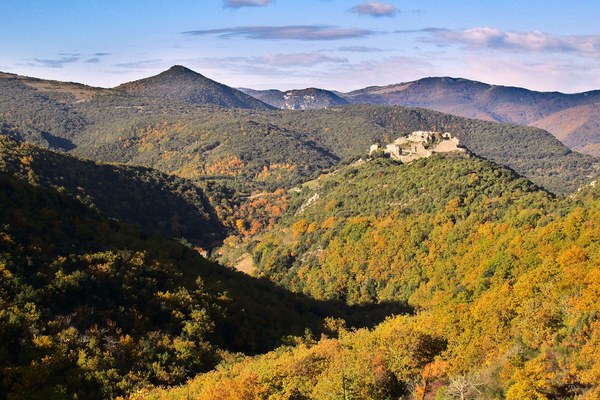
Termes, Villerouge and Lagrasse
Start at Termes, drive 25 minutes to Villerouge-Termenès and 20 minutes on to Lagrasse. One pass for the three places costs 17 euros.
- Termes: 400 metres from the reception, closed in winter
- Villerouge: open at weekends until 10 December 2026
- Lagrasse: the abbey from 779
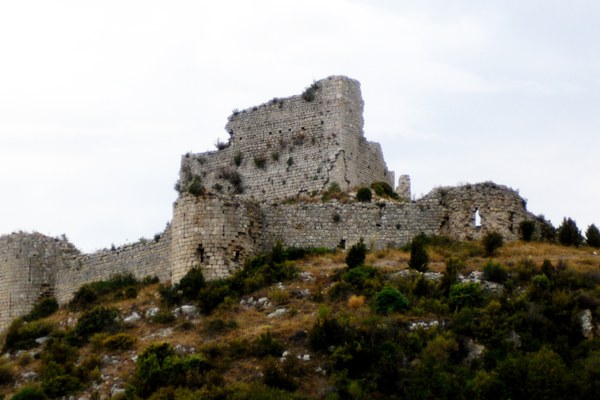
Aguilar and Quéribus
Start at Aguilar above Tuchan, and drive 30 minutes to Quéribus. Finish in Cucugnan below the castle.
- Aguilar: 296 metres, phone before you go in winter
- Quéribus: 728 metres, approx. 10 minutes on foot
- Cucugnan: the tourist office for the Corbières
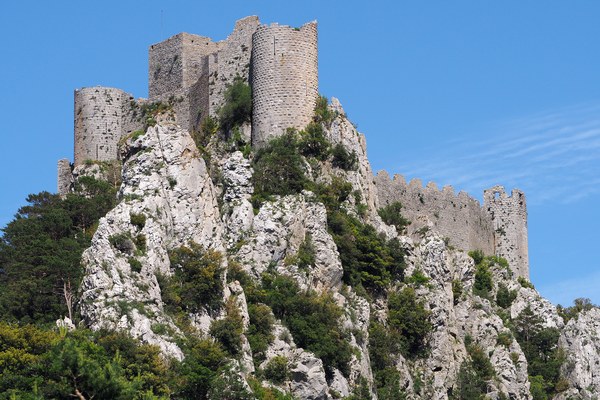
Peyrepertuse, Galamus and Puilaurens
Walk up to Peyrepertuse in the morning, drive through the Gorges de Galamus and on to Puilaurens. In winter Puilaurens is closed, so finish in Duilhac instead.
- Peyrepertuse: approx. 20 minutes from the ticket office
- Galamus: narrow road with alternating one-way traffic
- Puilaurens: the 2026 season was 21 March–11 November
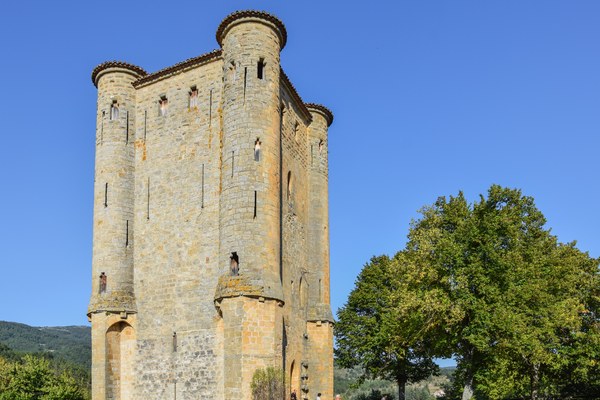
Arques and Carcassonne
See the keep in Arques in the morning, and drive to Carcassonne. Walk along the walls and into the Château comtal in the afternoon.
- Arques: the keep is 24 metres high
- Château comtal: last entry 45 minutes before closing
- Alternative: Lastours, with a loop of approx. 2 hours and 30 minutes