
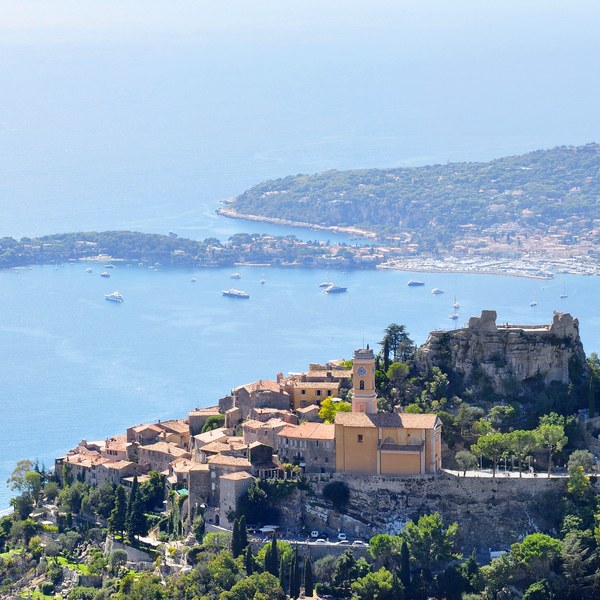
Èze is two places. Èze village is the medieval village on the cliff, and Èze-sur-Mer (Èze-bord-de-Mer) lies down by the sea, where the train stops. Between them there are around 400 metres of ascent, whether you walk the Chemin de Nietzsche or take the bus. It is just as easy to mix up the three Corniche roads: Èze village lies on the Moyenne Corniche, not on the Grande Corniche, while La Turbie and the Col d’Èze lie on the Grande Corniche.
Èze village – the castle and the church
According to the tourist office in Èze, people were already living on the cliff in the Iron Age, around 220 BC. The castle was built in the second half of the 12th century by the d’Èze family, and its ruins are now home to the Jardin d’Èze, at the top of the village.
The Église Notre-Dame-de-l’Assomption stands on the foundations of a 12th-century church. Today’s church was built from 1764 to 1778 by the architect Antoine Spinelli for Duke Charles-Emmanuel III of Savoy, and it was consecrated in 1772. The church has been protected as a monument historique since 5 December 1984.
The tourist office is on the place du Général de Gaulle (tel. +33 4 93 41 26 00). From 1 January 2026, coaches have to pay 80 euros to park in Èze.
Jardin d’Èze – the garden in the castle ruins
The Jardin d’Èze, also called the Jardin exotique, lies 429 metres above the sea in the ruins of the medieval castle, in the rue du Château. Among the plants stand sculptures by Jean-Philippe Richard.
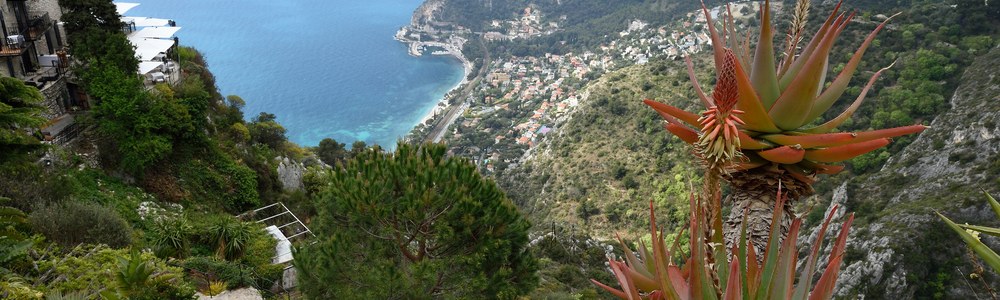
From 1 November to 31 December 2026 the garden is open every day from 9am to 4.30pm, with last admission at 4pm. It is closed on 25 December. Full price is 10 euros, and children under 12 go free. The tourist office in Nice gives two different reduced prices, 6 and 4 euros, on the same page – check at the ticket desk. A guided tour costs 15 euros.
Chemin de Nietzsche – the path from the sea
The Chemin de Nietzsche runs from Èze-sur-Mer up to Èze village. Côte d’Azur France gives 2.1 kilometres, 400 metres of ascent and one hour. Many travel guides say an hour and a half up and three quarters of an hour down, so allow 1–1.5 hours up. The path is free.
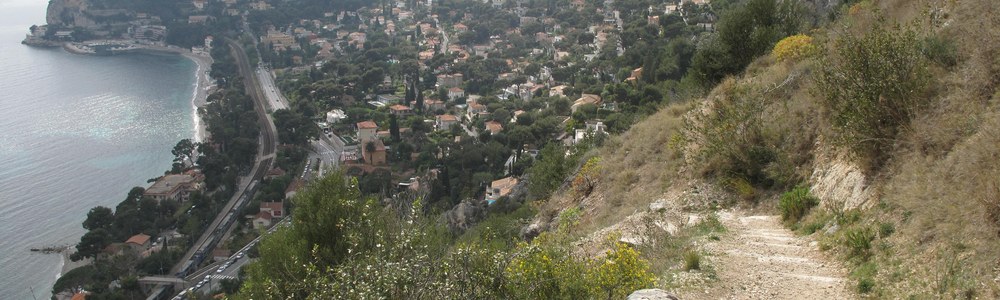
- Start: from Èze Bord de Mer station, walk 200 metres east along the Basse Corniche.
- Finish: the path ends in Èze village.
- Footwear: the path is steep, and walking boots are recommended.
- Children: the path is strongly discouraged for small children.
Friedrich Nietzsche lived in Èze and Nice from December 1883 to April 1884 and came back every year until 1888. According to Côte d’Azur France, he worked on the third part of “Thus Spoke Zarathustra” on this path.
The perfumeries
Fragonard has a factory and laboratory in Èze, the Usine Laboratoire d’Èze, at 158 avenue de Verdun on the Moyenne Corniche by the village. It opened in 1968. The guided tour is free, while the activities cost money and must be booked. Opening hours are 9am to 6.30pm every day, but they may vary with the season (tel. 04 93 41 05 05).
The perfume house Galimard, founded in Grasse in 1747, also has a perfumery in Èze, on the boulevard Maréchal Leclerc. Check tours and opening hours with Galimard before you go.
The three Corniche roads – which goes where
The three roads run side by side between Nice and Menton, each at its own height above the sea. The road numbers begin with M around Nice, but the signs switch between M and D along the way.
- The Basse Corniche (M6098) follows the sea from the harbour in Nice to Menton, via Villefranche-sur-Mer, Beaulieu-sur-Mer, Saint-Jean-Cap-Ferrat, Èze-bord-de-Mer and Cap d’Ail.
- The Moyenne Corniche (M6007) is the former Route nationale 7, the “route des vacances” from Paris to Menton. It runs a few hundred metres above the sea and passes Èze village.
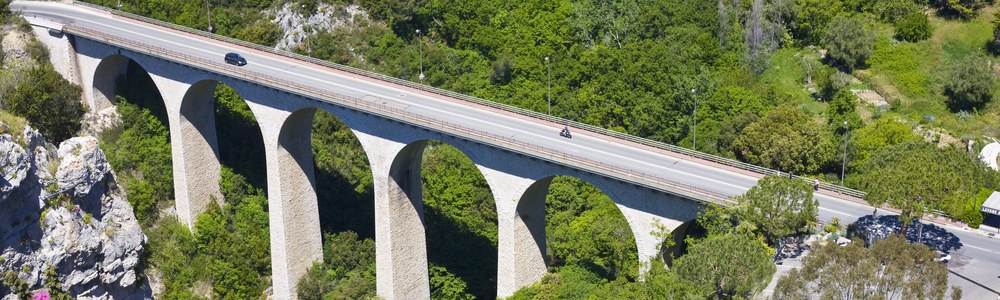
- The Grande Corniche (M2564/D2564) runs more than 400 metres above the sea along the ridge, from Mont Vinaigrier to the Cime de la Forna. It was built under Napoleon I on the Roman road Via Julia Augusta, and this is where you find the Col d’Èze, La Turbie and the Parc départemental de la Grande Corniche.
The Roman road Via Julia Augusta passed the foot of the Trophée d’Auguste in La Turbie, which was the highest point on the road. The Paris–Nice cycle race finishes on the Col d’Èze.
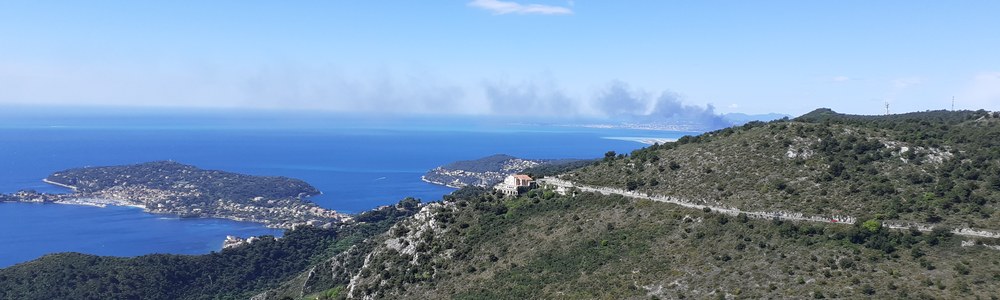
Choose your road by what you want to see: the Basse Corniche for the coastal towns and the villas, the Moyenne Corniche for Èze village and the Grande Corniche for the views from La Turbie and the nature park. By bus 600 along the coast from Nice to Menton, the tourist office in Menton gives around 1 hour and 40 minutes.
La Turbie and the Trophée d’Auguste
The Trophée d’Auguste in La Turbie stands 500 metres above the sea by the Grande Corniche. The monument celebrates the Emperor Augustus’s subjugation of the Alps around 14 BC, and the inscription names 45 Alpine peoples. It originally had a 35-metre base, a 12-metre-high platform and a rotunda with 24 columns. It was restored in the early 20th century, and the Edward Tuck museum is on the site.
The monument is open throughout 2026 but closed on Mondays: from 2 May to 31 August from 10am to 6pm, and from 1 September to 30 April from 10am to 1pm and 2pm to 5pm. A ticket costs 7 euros (reduced 5.50 euros), and it is free for everyone under 18 and for EU citizens aged 18 to 25.
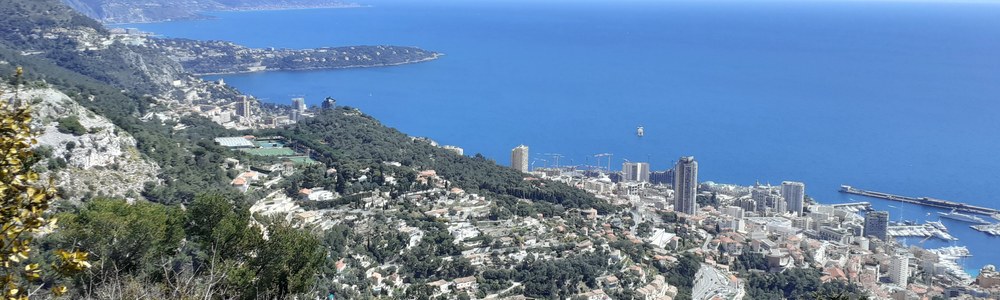
Along the Grande Corniche you will also find the Parc naturel départemental de la Grande Corniche, in the municipalities of Èze, La Trinité, La Turbie and Villefranche-sur-Mer. The park is free, with free parking, and it is open from 7.30am to 8pm from 1 April to 31 October and from 8am to 6pm from 1 November to 31 March. The views are from the Fort de la Revère. If you come on the A8 motorway, exit 57 is La Turbie.
Villefranche-sur-Mer and the Cocteau chapel
Villefranche-sur-Mer lies on the Basse Corniche. The Chapelle Saint-Pierre was decorated by Jean Cocteau and opened in June 1957, with the first mass on 30 June. The chapel is owned by the fishermen and was protected as a monument historique in 1996. It closes from around mid-November to mid-December – in 2026 from 22 November to 22 December – so check before you go.
The citadel dates from the mid-16th century, but the museums there have been closed for renovation. Cocteau’s own museum, Le Bastion, is in Menton – more about it in the travel guide to Menton.
Saint-Jean-Cap-Ferrat and the Villa Ephrussi de Rothschild
The Villa & Jardins Ephrussi de Rothschild is at 1 avenue Ephrussi de Rothschild in Saint-Jean-Cap-Ferrat, with nine themed gardens around the villa. It is open every day: Monday to Friday from 10am to 4.30pm and at weekends and in the school holidays from 10am to 6pm. It is closed on Monday 14 December 2026.
The tourist offices give 18 euros for 2026, 12 euros reduced and free for children under 7. If you also want to see the Villa Kérylos in Beaulieu, the combined ticket is worth it: 24 euros for both, valid for eight days.
Beaulieu-sur-Mer and the Villa Kérylos
The Villa Kérylos in the rue Gustave Eiffel in Beaulieu-sur-Mer was designed in the early 20th century. From 1 October to 31 March it is open from 10am to 5pm, and from 1 April to 30 September from 10am to 6pm, with evening opening until 10pm in certain periods from May to September. It is closed on 1 January, 1 May and 25 December. A ticket costs 15 euros (reduced 10 euros), and the combined ticket with the Villa Ephrussi costs 24 euros.
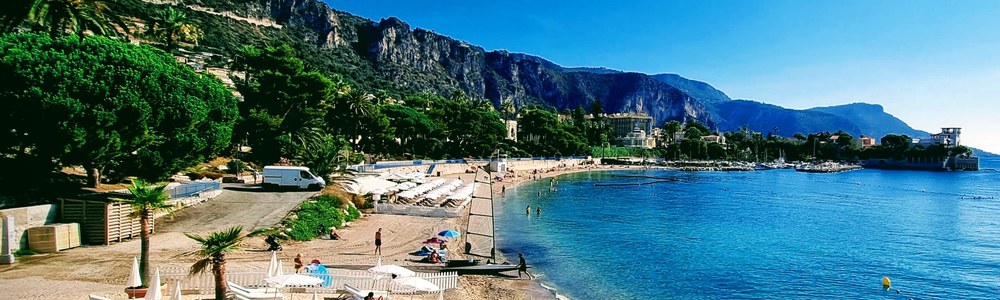
Beaulieu lies on the Basse Corniche, and bus 600 between Nice and Menton stops here.
Roquebrune-Cap-Martin – the castle and the coastal path
The Château de Roquebrune was built in the 10th century and, according to Côte d’Azur France, is one of the few examples of Carolingian architecture in France. The castle was originally the keep of a fortification around the whole village and was long the property of the Grimaldi family. Roquebrune voted to become French in 1861, and William Ingram gave the castle to the municipality in 1921.
From 2 November to 24 December 2026 and from 2 January to 31 March 2027 the castle is open every day from 10am to 5pm, and from 1 April to 31 October 2027 from 10.30am to 6.30pm. Last admission is 30 minutes before closing. Adults pay 5 euros, children from 6 and students 3 euros, and children under 6 go free. The castle is not wheelchair accessible.
Down by the sea runs the coastal path around Cap Martin (Promenade Le Corbusier): 4.7 kilometres one way from Carnolès station to Cap Martin–Roquebrune station, with around 50 metres up and down. The path passes Le Corbusier’s Cabanon and Eileen Gray’s villa E-1027. The interiors can only be seen on a guided tour with Cap Moderne, booked online, from 1 April to 31 October. In 2026 there were four departures a day, at 10am, 11am, 2pm and 3pm, and the price was 18 euros. The tour is not suitable for people with reduced mobility.
Eating and sleeping
Èze village has two five-star château hotels. The Château de la Chèvre d’Or (45 rooms) lies inside the medieval village, and its restaurant has two stars in the Michelin Guide, with head chef Tom Meyer. The Château Eza is smaller, with 14 rooms, and its restaurant has one Michelin star, with head chef Justin Schmitt and a terrace above the sea.
Down by the sea in Èze-bord-de-Mer, La Table du Cap Estel has one Michelin star, and along the Basse Corniche, Le Restaurant des Rois at La Réserve de Beaulieu and Le Cap at the Grand-Hôtel du Cap-Ferrat have one star each. Michelin also recommends Les Remparts in Èze and the Café de la Fontaine in La Turbie.
If you want more hotels to choose from, Menton is a good base, with hotels from two to five stars and trains and buses along the coast.
Train and bus – getting around without a car
Train: the TER train along the coast stops at Èze station, also called Èze-sur-Mer or Èze-bord-de-Mer, on the Basse Corniche. The station is down by the sea, not in the village: Èze village lies 400 metres higher up. From there you walk the Chemin de Nietzsche or take the bus.
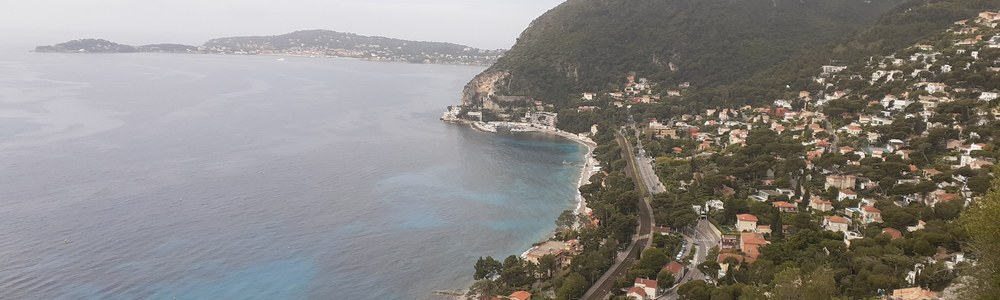
Bus 600: ZOU! line 600 runs along the Basse Corniche from Nice (Square Normandie Niemen) via Villefranche, Beaulieu, Èze-sur-Mer, Cap-d’Ail, Monaco and Roquebrune to the bus station in Menton. In Èze it stops at “Gare Eze”, “Cap Estel” and “Parking Saint-Laurent d’Eze”.
Up to the village: Lignes d’Azur line 82 runs from Nice (Vauban) to Èze village, and line 83 runs from the station in Èze-sur-Mer up to the village and the Grande Corniche. We have not been able to confirm the routes with Lignes d’Azur, so check before you travel.
Travel pass: the Pass Sud Azur gives unlimited travel for 3, 7 or 14 days on trains, buses and trams in Alpes-Maritimes and Monaco.
Plane, car and bike: Nice Côte d’Azur Airport is 42 kilometres from Menton. By car, take the A8 motorway and exit 57 for La Turbie. The cycle route from Nice to Menton is 39 kilometres – you will find a shorter version in The 10 most beautiful bike rides in France.
The coast roads with Menton as your base
Menton lies between Monaco and Italy, with the Menton and Menton-Garavan railway stations and the bus station for bus 600 and airport bus 80. From here it is a short way to Roquebrune-Cap-Martin, and Monaco is around ten minutes away by train – read more in A day trip to Monaco. If you are staying in Nice, you will find the city in the travel guide to Nice and the whole coast in Côte d’Azur.
4 days along the Corniche roads
With four days you have time for Èze, the Grande Corniche and La Turbie, Villefranche and the villas by the sea. You can reach most of the places by train and bus 600, while the Grande Corniche and La Turbie are easiest by car.
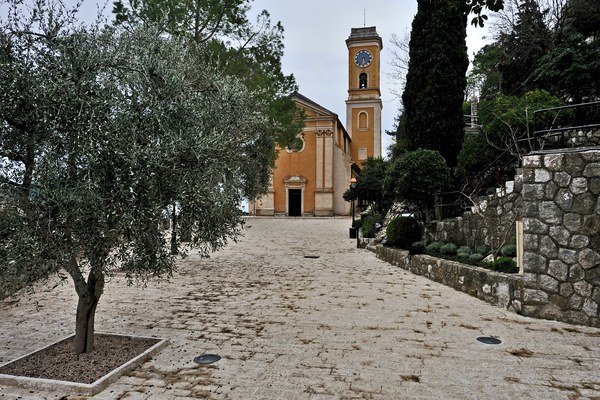
The Chemin de Nietzsche and Èze village
Take the train to Èze-sur-Mer and walk the Chemin de Nietzsche up to the village. See the church and the Jardin d’Èze, and join the free tour at Fragonard on the Moyenne Corniche.
- 2.1 kilometres and 400 metres of ascent
- The garden: 10 euros, free under 12
- Walking boots, not for small children
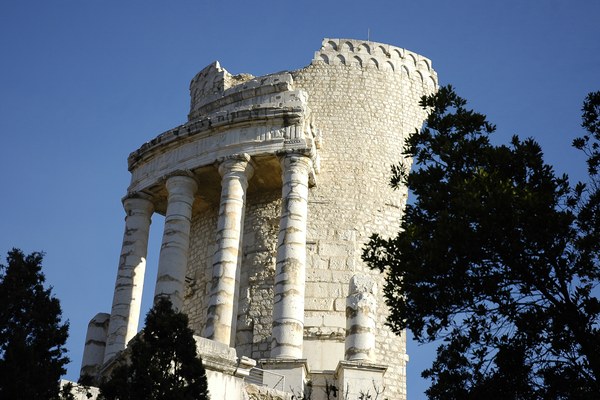
The Grande Corniche, La Turbie and Roquebrune
Drive the Grande Corniche with stops in the nature park and at the Fort de la Revère. See the Trophée d’Auguste in La Turbie, and finish at the castle in Roquebrune.
- The Trophée d’Auguste is closed on Mondays
- The nature park is free
- The castle: 5 euros for adults
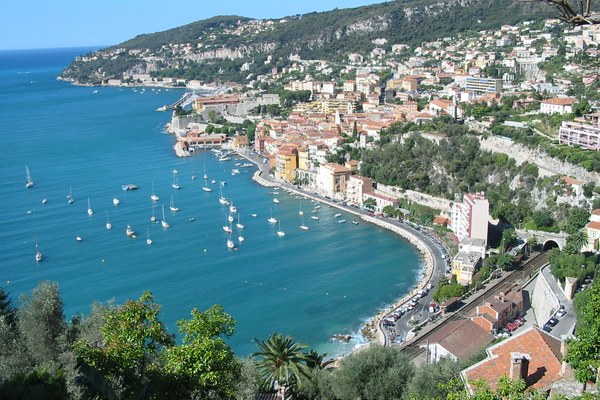
Villefranche-sur-Mer and the Basse Corniche
See Cocteau’s Chapelle Saint-Pierre in Villefranche-sur-Mer, and take bus 600 on along the Basse Corniche to Beaulieu-sur-Mer.
- The chapel is closed from around mid-November
- Bus 600 stops in both towns
- No car needed
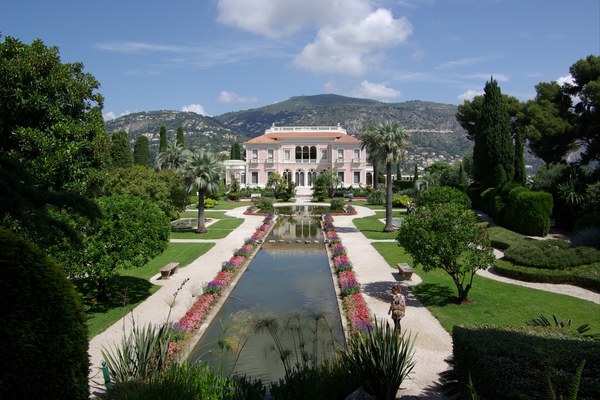
The Villa Ephrussi and the Villa Kérylos
Use the combined ticket: the Villa Ephrussi de Rothschild and the nine gardens on Cap Ferrat in the morning, the Villa Kérylos in Beaulieu in the afternoon.
- Combined ticket: 24 euros, valid for 8 days
- Ephrussi: until 4.30pm on weekdays
- Kérylos is closed on 1 Jan, 1 May and 25 Dec