
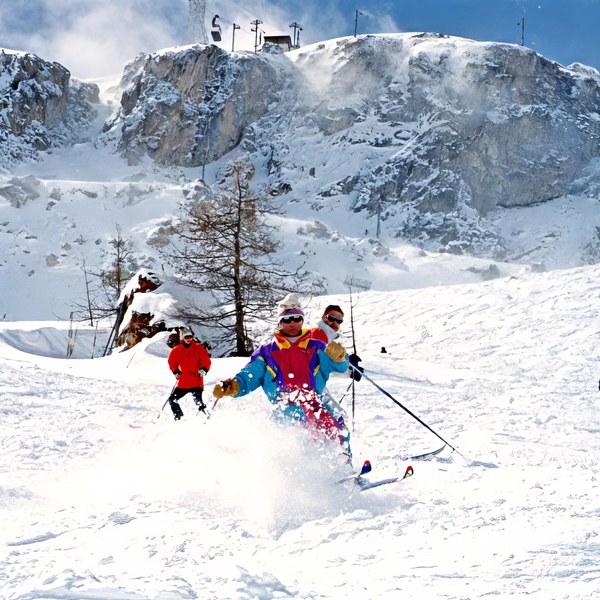
The whole ski area lies in the Savoie department, in the Auvergne-Rhône-Alpes region – not in Haute-Savoie. The tourist offices have the websites valdisere.com and tignes.net, and the lift passes are sold by Val d'Isère Téléphériques and by SPL ALTTA in Tignes (skipass-tignes.com). The prices and dates in this guide are from the sources in autumn 2026 – check them before you go.
Pistes, lifts and the highest point
The tourist office in Val d'Isère gives more than 300 kilometres of pistes, around 160 runs and 71 lifts. The lowest point is Tignes les Brévières at approx. 1,550 metres, and the lifts on the Grande Motte glacier go to 3,456 metres. The Grande Motte summit itself is approx. 3,650 metres high, but the lifts go no higher than 3,456 metres.
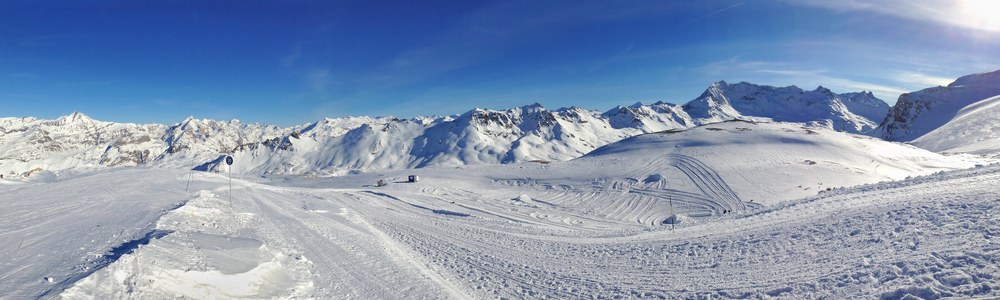
- The runs: 23 green, 67 blue, 41 red and 29 black, according to the tourist office.
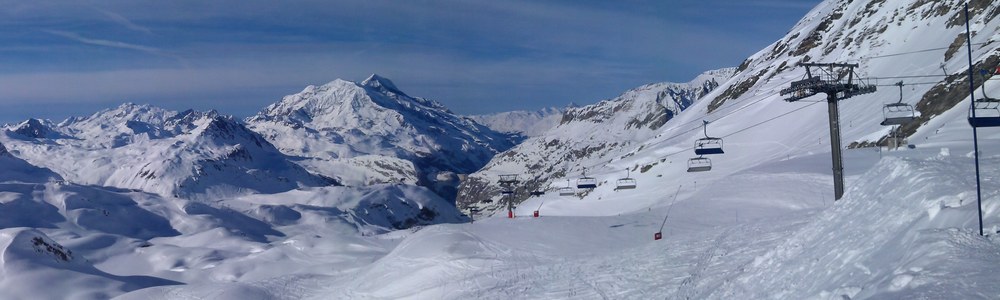
- The lifts: 11 of the 71 are open to pedestrians. Val d'Isère Téléphériques, owned by Compagnie des Alpes, runs 42 of them.
- The glaciers: two – the Grande Motte in Tignes and the Pisaillas on the Val d'Isère side.
- The altitude: according to the lift company in Val d'Isère, 60 per cent of the pistes lie above 2,000 metres.
- Artificial snow: snow cannons along more than 65 kilometres of pistes.
The figures vary a little between the sources. The lift company in Val d'Isère also writes 300 kilometres and 71 lifts, but gives the skiable area as 1,830 to 3,185 metres, while the tourist office writes from 1,550 to over 3,400 metres.
Lift passes 2026–27
The Tignes – Val d'Isère pass is valid in the whole area. The prices below are from the lift pass page of SPL ALTTA in Tignes:
- Adults (19–64): 78 euros for one day and 468 euros for the “6 jours = 7” pass – seven days for the price of six.
- Children (8–18) and seniors (65–74): 63 euros for one day and 378 euros for “6 jours = 7”.
- Free: children under 8 and everyone aged 75 and over.
- Season pass: 1,130 euros for adults and 915 euros for children and seniors.
- Families: if you buy at least four “6 jours = 7” passes or longer at the same time, with at least two children aged 8–18 and two adults aged 19–64, the lift company in Val d'Isère gives a discount of 330 euros.
- Bonus: the “6 jours = 7” pass gives two free entries to the Centre Aquasportif swimming complex.
- Insurance: Carré Neige costs 3.50 euros per day.
- Pedestrians: a day pass for pedestrians in Tignes costs 25 euros, reduced price 20 euros. New this winter is a six-day pedestrian pass for Tignes – Val d'Isère, with almost 20 lifts.
The lift company in Val d'Isère also has the “Ski à la carte” scheme, where a day costs 67 euros in low season and 78 euros in high season, the same price for everyone from 8 to 74. We have not found prices for passes valid only in Val d'Isère. You will find the full price list at Val d'Isère Téléphériques and SPL ALTTA in Tignes.
To book a ski holiday with accommodation here, search with our ski partner: Val d'Isère or Tignes.
The season and the crowds
Tignes opens a week before Val d'Isère, and both stay open until 2 May 2027:
- Tignes: 21 November 2026–2 May 2027, with the Opening weekend on 21–22 November.
- Val d'Isère: 28 November 2026–2 May 2027. The first weekend, 28–29 November, is called “Premières Traces”.
- French school holidays: the Christmas holidays are 19 December 2026–4 January 2027, and from 6 February to 8 March 2027 at least one of the three French zones has its winter holidays. February is the busiest month.
- April: the lift company in Val d'Isère sells packages under the name “Le Ski d'Avril”, with discounts of up to 40 per cent.
- Our advice: January after 4 January and March after 8 March fall outside the French school holidays. December and April have low-season prices.
The men’s World Cup comes to Val d'Isère on 12–13 December 2026, and the Para Alpine World Championships are held in Tignes on 7–19 March 2027.
Val d'Isère: La Face and the 1992 Olympics
La Face de Bellevarde became famous in 1992, when the men’s Olympic alpine events were held here: the downhill, giant slalom, super-G and combined. The host city was Albertville, and the men’s slalom was held in Les Menuires. According to the tourist office, the idea of bidding for the Olympics came from Jean-Claude Killy and Michel Barnier during the Critérium race in 1981.
- The slope: the gradient is up to 71 per cent, and the run is more than 2,900 metres long, with more than 850 metres of vertical drop down to the centre. The lift company writes “débutants s'abstenir” – it is not for beginners.
- Olympique: the cable car from 2002 was the first 3S cable car built in France, and it takes six minutes up to the Rocher de Bellevarde, approx. 2,830 metres. From La Daille, the Funival funicular goes up.
- Critérium de la Première Neige: the race was first held in 1955. In 2026 the men’s World Cup is held on the Face de Bellevarde, with the giant slalom on Saturday 12 December and the slalom on Sunday 13 December.
- OK: the run in La Daille is known from the women’s Critérium races. It is 5,640 metres long, with 900 metres of vertical drop.
- The 2009 World Championships: the Alpine World Ski Championships in Val d'Isère had 11 events on Bellevarde and Solaise.
The village has kept the old church of Saint-Bernard-de-Menthon. The bell tower dates from 1664, and the 33-metre octagonal spire is one of the few spared by the revolutionaries in 1794. The 1979 comedy “Les Bronzés font du ski” was filmed in Val d'Isère.
Tignes: five villages
The first ski lift in Tignes came in 1936. After the dam was built, the resort moved up to 2,100 metres, and in the 1970s it became an international ski resort. Today Tignes has five parts:
- Tignes les Brévières (1,550 metres): the lowest, with traditional chalets at the foot of the dam.
- Tignes 1800: lies around the copy of the old church, with the “des Boisses” gondola.
- Le Lavachet: the quietest of the three villages at 2,100 metres.
- Tignes le Lac: the centre, by the lake, with Le Lagon and the Maison de Tignes.
- Val Claret: nightlife, competition venues and the Lognan stadium.
At the 1992 Olympics Tignes hosted freestyle, with moguls and demonstration events. In March 2027 the Para Alpine World Championships are held at the Lognan stadium in Val Claret. In summer Tignes has an 18-hole golf course at 2,100 metres – according to Tignes, the highest in Europe.
The Grande Motte glacier and summer skiing
On the Grande Motte, the Perce-Neige funicular goes to 3,032 metres, and from there the cable car takes you to 3,456 metres in seven minutes. Up there are blue, red and black runs. There is no skiing here all year round, but the glacier still has summer skiing for a few weeks.
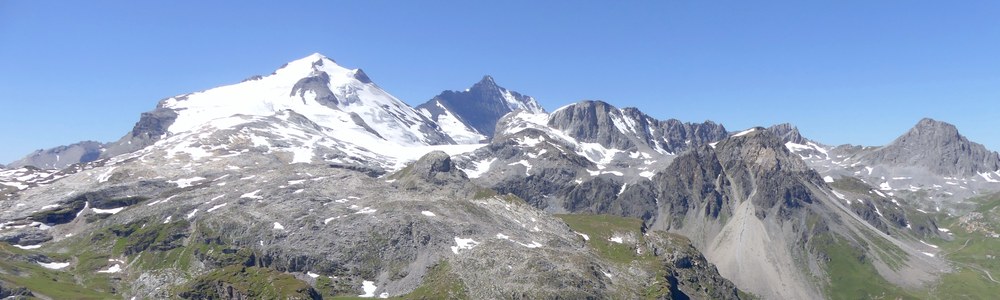
- Summer skiing on the Grande Motte: in 2026 the glacier was open 20 June–15 July, between 3,456 and 2,724 metres. The dates for 2027 have not been published.
- Pisaillas in Val d'Isère: here there is summer skiing for a few weeks in June, depending on the snow and on the road to the Col de l'Iseran being open. In 2026 it was 6–21 June, with a day pass at 37 euros.
- The nature reserve: the glacier lies in the Tignes-Champagny nature reserve from 1963. Dogs are banned, even on a lead, and you must not pick anything.
- Le Panoramic: the restaurant at the top of the funicular, at 3,032 metres, is recommended in the Michelin Guide and is open every day 9am–4.30pm. You need a lift pass or a pedestrian pass to get there.
Lac du Chevril and the village under the water
The old village of Tignes lies at the bottom of the Lac du Chevril. The dam was built in 1946–1952, the inhabitants had to move, and in 1952 the village was flooded. They built a new village higher up, Les Boisses.
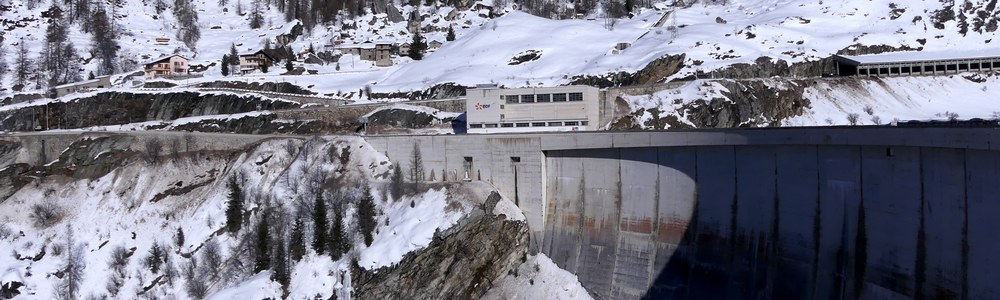
- The dam: the Barrage du Chevril is 180 metres high and 300 metres long. The lake holds 230 million cubic metres of water and covers 3.2 square kilometres.
- The construction: in the summer of 1949 up to 5,600 workers were on the site. Today the power station supplies the electricity used by 392,000 inhabitants.
- The church: Saint-Jacques in Tignes 1800 is a copy of the drowned church, with the original furnishings and altarpieces.
- The art: the sculpture “La Dame du Lac” (2002) by Livio Benedetti stands at Villaret du Nial on the road to Val d'Isère. The fresco “Hercule” by Jean-Marie Pierret from 1989, covering 12,000 square metres of the dam wall, has almost disappeared.
- Guided tours: in summer there are guided tours at the dam.
Beginners, families and advanced skiers
Val d'Isère has the Famille Plus label, and the area has slopes for all levels. Most of what follows is from Val d'Isère:
- Beginners: the Jardin des Neiges and the green La Savonnette run at the bottom of the slopes (front de neige), free lifts for beginners and dedicated “Ski Tranquille” zones on Solaise and Bellevarde.
- Families: the ValKids area at the top of Solaise, the themed run “Sur la trace du Gypaète” and a special pass for one ride on the Solaise gondola and ValKids. The Village Perdu playground at 2,000 metres in the La Daille forest is only for skiers who can handle ungroomed terrain.
- Advanced skiers: La Face and OK, the Val Park snow park at 2,500 metres, two marked ski touring areas and off-piste with a ski school or a guide.
You will find more ski resorts in the Alps in skiing in the French Alps, and the neighbouring area in Les 3 Vallées.
Snow reliability
The tourist office in Val d'Isère counts on almost five months of skiing, from the end of November to the beginning of May, and the lift company writes that the snow is guaranteed from December to the beginning of May. Most of the runs face north, there is artificial snow along more than 65 kilometres, and the area also gets snow with the “retour d'Est” – snowfall that comes in from Italy. Sixty per cent of the pistes lie above 2,000 metres.
Summer: Lac de Tignes, lifts and cycling
In summer 2026 the lifts in Val d'Isère were free for pedestrians 4 July–30 August, among them the Solaise gondola and the Olympique cable car. Cyclists pay. We had not found the dates for summer 2027 when this guide was written – check them with the tourist office.
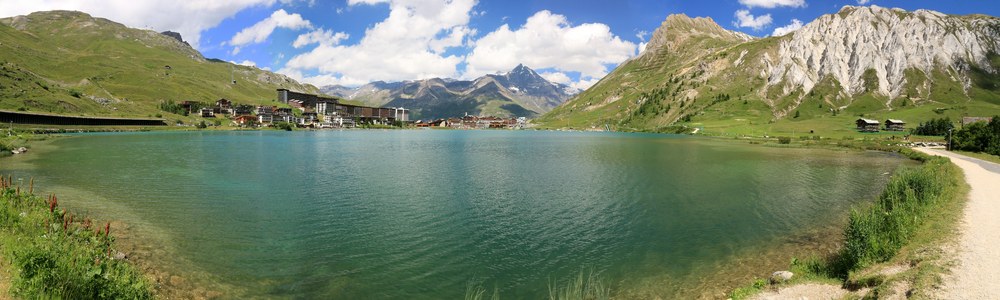
- Lac de Tignes: the natural lake at 2,100 metres is fed by the Grande Motte glacier. Here you can paddle, canoe, fish and try Acroland. On Mondays and Thursdays there are concerts from the barge “la Barge”.
- Cycling: the Bike Park Tignes – Val d'Isère. The Olympique cable car also takes cyclists, but they pay for the ride.
- More to do: via ferrata and the Val Pass activity card in Val d'Isère.
- Summer skiing: the Pisaillas for a few weeks in June and the Grande Motte in June–July.
You will find more bike rides in the most beautiful bike rides in France.
Col de l'Iseran
The Col de l'Iseran is the highest paved mountain pass in the Alps – a road over a pass, at approx. 2,770 metres (2,764 metres on the map). The road links Val d'Isère in the Tarentaise with Bonneval-sur-Arc in the Maurienne and is part of the Route des Grandes Alpes.
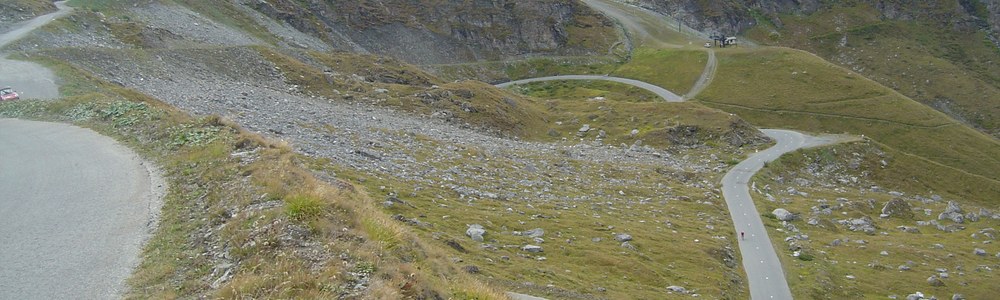
- The history: the road was inaugurated on 10 July 1937 by President Albert Lebrun.
- The gradient: max. 7 per cent on the Val d'Isère side.
- Open: from June to October, depending on the snow. Snow clearing starts in May and takes several weeks, and in winter the road is closed.
- At the top: the chapel of Notre-Dame de Toute Prudence from 1939 and the restaurant La Cascade at the foot of the Pisaillas glacier. In July and August there are guided tours.
- The cycling event: L'Iserane runs on 27 June 2027 from Val d'Isère over the pass to Bonneval.
- In winter: from Le Fornet you take the cable car and the Vallon gondola to 2,790 metres, and from there a path leads to the foot of the Pisaillas glacier and the chapel. Pedestrians need a pedestrian pass.
Getting to Val d'Isère and Tignes
By air: from the Nordic countries you usually fly to Geneva or Lyon. Chambéry and Grenoble are closer, but we have not found routes there from the Nordic countries. According to the tourist office in Val d'Isère, the distances and driving times to Val d'Isère are:
- Bourg-Saint-Maurice: 30 kilometres, approx. 40 minutes.
- Chambéry and Grenoble: 135 kilometres (approx. 2 hours) and 165 kilometres (approx. 2 hours 30 minutes).
- Geneva and Lyon: 220 and 240 kilometres, approx. 3 hours to both.
- Train: the nearest station is Bourg-Saint-Maurice. The TGV runs from Paris all year round, and in winter there are also OUIGO and the Travelski Night Express night train – new in 2026–27 direct from Amsterdam, Rotterdam, Antwerp and Brussels. From London the Eurostar runs with a change, and on some Saturdays in winter direct.
- Extra TGV: at the weekends from 27 November to 12 December 2026 there are extra TGV INOUI trains between Paris Gare de Lyon and Bourg-Saint-Maurice, with connecting buses.
- Bus: Altibus line S82 runs from Bourg-Saint-Maurice to Val d'Isère and S83 to Tignes, all year round, approx. 40 minutes. Luggage and one pair of skis are included. The bus station in Val d'Isère has moved to La Daille.
- Airport bus: the direct buses from Geneva and Lyon to Val d'Isère run only in winter.
By car: the Col de l'Iseran is closed in winter, so the D902 from Bourg-Saint-Maurice is then the only road in. From 1 November to 31 March you must carry snow chains or snow socks in the car or have four winter tyres, and since November 2024 only tyres marked 3PMSF are accepted. The tourist office recommends stays from Sunday to Sunday to avoid the Saturday traffic. The car hire box on this page uses Lyon airport.
Eating and sleeping
Val d'Isère has 33 classified hotels, eight of them with five stars, and Tignes has 22. None of them has the state Palace distinction. In the middle of Val d'Isère is the five-star Hôtel Le Blizzard, which is open both in winter and in summer, the family-run Maison de Famille Les 5 Frères with three stars and Hôtel La Galise with two. In Val Claret in Tignes is the five-star Les Suites – Maison Bouvier.
La Table de l'Ours in Val d'Isère and Ursus in Val Claret have one Michelin star each. Michelin also recommends La Table de Jeanne in Val Claret and Le Panoramic on the Grande Motte glacier, and there is no Bib Gourmand in the area. You will find the rest of the hotels and restaurants in the travel guide to Val d'Isère.
Onward from Tignes and Val d'Isère
Tignes and Val d'Isère belong to the Haute-Tarentaise sector of France’s first national park – read more in Vanoise National Park. If you want to see more of the Alps, we have a travel guide to Courchevel and a travel guide to Chamonix below Mont Blanc.
4 days in Tignes and Val d'Isère
With four days and the Tignes – Val d'Isère pass you have time for the whole area: Bellevarde and La Face, Solaise and Le Fornet, Tignes and the Grande Motte, and the Pisaillas glacier by the Col de l'Iseran. The route works when both resorts are open, 28 November 2026–2 May 2027.
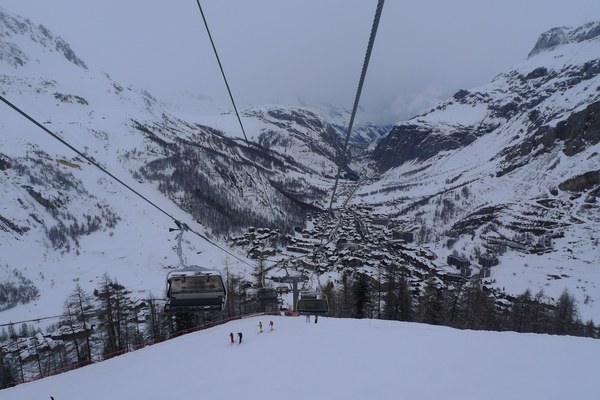
Bellevarde and La Face
Take the Olympique cable car up to the Rocher de Bellevarde. Advanced skiers can ski La Face down to the centre, while others stay in the Ski Tranquille zone on Bellevarde. Have dinner at La Table de l'Ours, which has one Michelin star.
- Olympique: six minutes to the top
- La Face: gradient up to 71 per cent
- La Table de l'Ours: Tuesday–Saturday
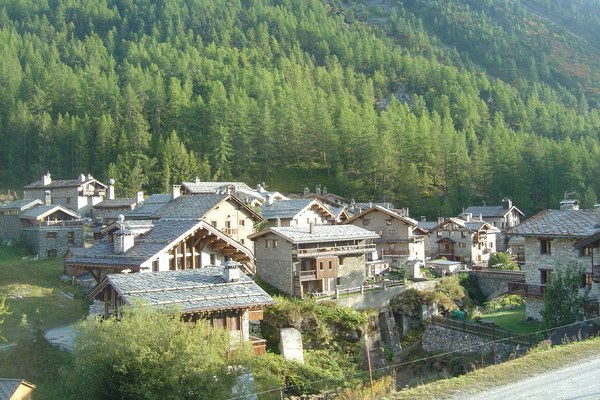
Solaise and Le Fornet
Take the Solaise gondola up and warm up in Le Lounge de Solaise at 2,550 metres, a free heated shelter with a café and two sun terraces. Ski the Ski Tranquille zones on Solaise, and see Le Fornet in the afternoon – the village at 1,930 metres is named after lime kilns, and the oldest houses date from 1750.
- Le Lounge: a free 250 m² heated shelter
- ValKids for the children at the top
- Le Fornet: approx. 70 permanent residents
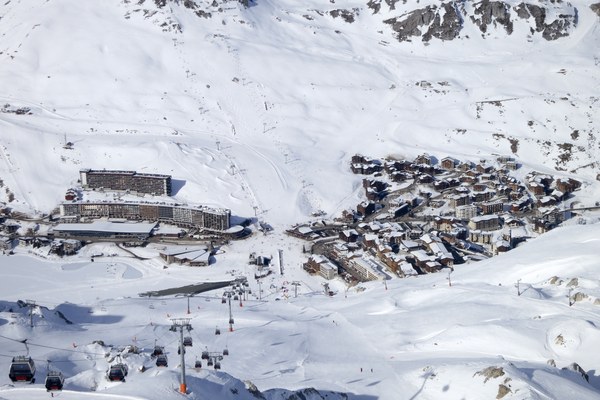
Tignes and the Grande Motte
Ski over to Tignes via the Tommeuses link and on to the Grande Motte. The Perce-Neige funicular goes to 3,032 metres and the cable car to 3,456 metres – you cannot get this high by lift anywhere else in the area. Have lunch at Le Panoramic and ski down to Tignes le Lac in the afternoon.
- Le Panoramic: every day 9am–4.30pm
- The cable car to 3,456 metres
- Ursus in Val Claret: dinner Tuesday–Saturday
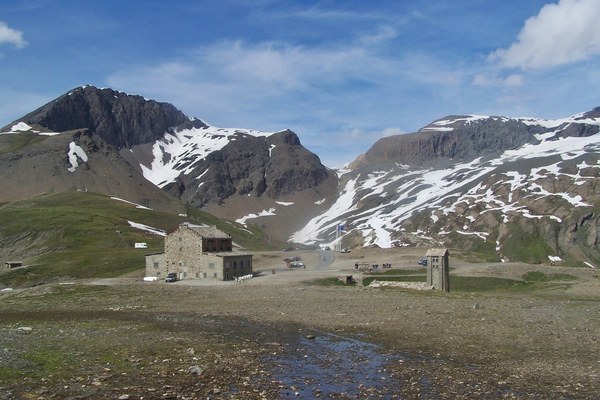
Pisaillas and the Col de l'Iseran
Take the cable car from Le Fornet and the Vallon gondola to 2,790 metres. Skiers can take the Montets drag lift up to approx. 3,200 metres, the highest point in Val d'Isère. Pedestrians follow the path to the foot of the Pisaillas glacier and the chapel on the Col de l'Iseran – the road over the pass is closed in winter.
- The cable car from Le Fornet dates from 1972
- Pedestrians need a pedestrian pass
- Winter walk Le Fornet–Pont Saint-Charles: 6 km return